Print Friendly and PDF

Sunday, November 16, 2025

The Salt Lake Temple VI: A Hollow Shell

 Previously: The Crossroads of the West


At the 1852 LDS general conference, Heber Kimball admonished Church members to go to Manti to claim around 100 abandoned homes. He also said similar opportunities existed in Iron County. (See JD 1:295)

Can you imagine it? Hundreds of abandoned homes in the Utah Territory only five years after the Mormons arrived? Why were so many houses built and abandoned in such a short timespan?

I covered that quote in my post on the Manti Temple, but I bring it up here because in the same conference we're told that both Heber Kimball and Brigham Young deliberated on potential building materials for the Salt Lake Temple. Brigham's comments here are particularly interesting.

Young claimed that he was "a chemist in theory," and that the San Pete rock, red sandstone, and bastard marble or limestone, would all wash away long before "mud or adobes." He then went on to claim that ancient builders used adobes, or "clay mixed with straw," and that Egyptian "monuments, towers, and pyramids," made of the same material, were then still standing (See JD 1:218-220).

Yet ironically, not a single adobe structure supposedly built in Utah is still standing today. The Egyptian pyramids, specifically the pyramid of Giza, were constructed of limestone and granite, not adobes. Structures made of a specific type of fired clay known as terra cotta can last multiple centuries, but it does not contain straw. The Joseph Smith Memorial Building has terra cotta on its facade. 

So why would the narrative have Brigham Young making such a seemingly foolish and contradictory statement? The Salt Lake Temple was, after all, built with granite and red sandstone, not clay mixed with straw. 

I'm beginning to discover a pattern in written history. The stories we are told seem to be full of contradiction and irony, as well as diversity and duality. In my opinion this is by design, with these concepts being written into the historical narratives almost like they were algorithms or code. They appear in many old world building narratives, not just in America, but all over the world.

When something repeats often enough, it can no longer be called a coincidence. 

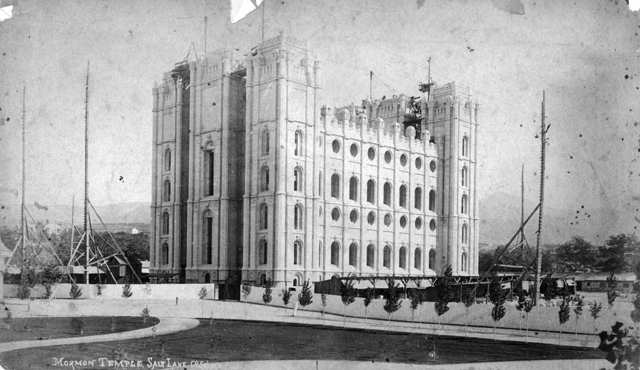
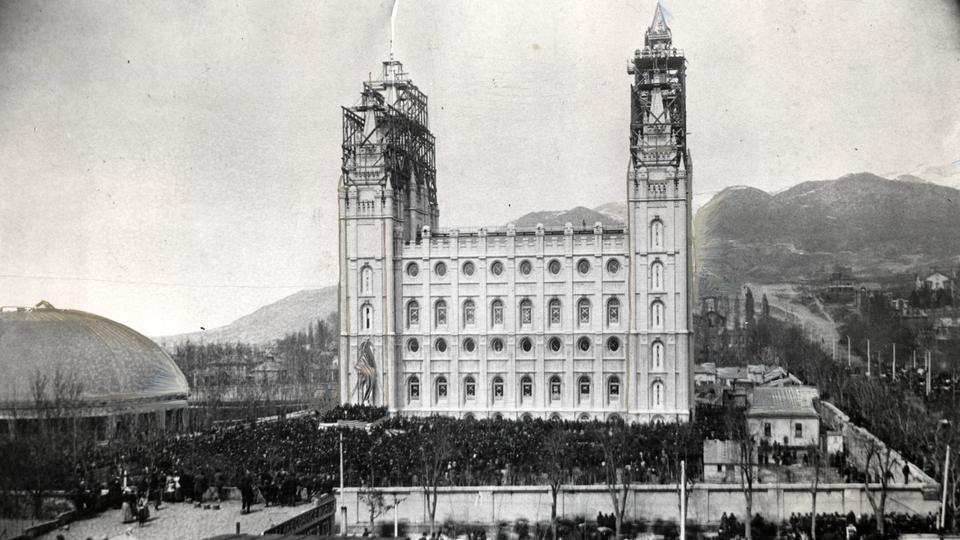
In this post I'll be covering the construction of the temple up to 1892, just before the final capstone was placed at towering heights of over 200 feet. Author Mark Henshaw claims that before the roof was finished in 1889, the temple resembled "an empty shell" (See Forty Years: The Saga of Building the Salt Lake Temple, p. 525). Can you imagine a massive granite structure with walls over 100 feet tall, with nothing in the interior to hold them together? 

It's certainly plausible that some stone buildings were constructed this way (like a castle for example), with no interior lumber or steel to hold the building together. The walls of the Salt Lake Temple are 6 feet thick at the base and tapered to 3-4 feet thick at the top of the battlements. 

However, if a construction project had a planned interior from the start, with multiple floors, then why would the builders try to insert framed-in floors later? Especially on a structure over 200 feet tall? This would be very difficult to do.  

This claim (that interior floors were added later to the SLT) is reminiscent of the St. George Temple, which as you may recall, was built so hastily that the 80-foot walls began leaning inward for lack of interior supports. Lumber was sourced over 70 miles away in Trumbull, Arizona, and crews couldn't ship it up to St. George fast enough.

As a consequence of this, we're told, the interior floors and supports had to be constructed later while workers simultaneously attempted to straighten 80-foot walls made of stone. The story is ridiculous and hinges upon the miraculous, but in real life, buildings are not constructed this way. 

Interior framing, whether steel or wood, is always constructed simultaneously with exterior walls, and if stone walls are built as stand-alone structures, they are always buttressed with stone supports. The Salt Lake temple was built with buttresses, but they appear decorative and not load bearing. 

If you search for construction photos of the Salt Lake temple (I'll show some later in this post), you'll notice that each phase of construction features a finished granite structure abruptly cut off at the top, with each photo displaying varying stages of progress. You'll notice that the facade is always finished, meaning that the hand-carved granite designs always appear from the bottom going up, even though the top hasn't been completed. 

This is another red flag. 

Buildings are not constructed this way. Facade designs are always done last, after the structure is framed and supported. Yet in the story of the Salt Lake temple, facades were simultaneously finished as the walls of the building rose, and we’re told that the interior was finished in record time.

There is not a definitive timeline in the historical record revealing when the work on the interior actually began. According to some sources (which I will get into in the next post), work on the interior framing began as early as 1889, however, most of the available documents that say anything about the interior claim that the bulk of the work was done in only one year--from April 1892 to April 1893.

Even if floors were framed before 1892, it was still nothing short of a miracle that laborers were able to complete the temple with such incredible workmanship and exquisite detail in only one year. By all rights it should've taken years and years--especially with the limited tools and tech available during the 1890s. 

This is not something our modern civilization could repeat today (it's taken the LDS Church nearly 8 years just to renovate the Salt Lake Temple with modern equipment). 

The capstone ceremony and interior construction will be the subject of the next post. For now, let's unpack the quarries and stone walls. 

Little Cottonwood Quarry

When I think of a quarry, I imagine stone being excavated from the side of a mountain, or layered rock being cut out of the earth, like what's happening in the marble quarry below:


This is not the case with the temple quarry in Little Cottonwood Canyon. The historical account claims that large boulders, some already in a square-ish form, had fallen down from the granite cliffs and were resting on the sides and bottom of the canyon. Quarry workers split these boulders with hand drills and wedges, and then loaded them onto wagons and hauled them 20 miles to the temple site. 

Here is what Little Canyon looks like today. Does it look like the site of a quarry?


I was curious about this quarry, so I planned a trip to Little Cottonwood and checked it out for myself. I hiked along the temple quarry interpretive trail and examined the boulders that still have drill marks on them. However, I didn't find enough evidence to convince me that a quarry actually existed there, at least not in the way LDS historians claim. Here’s a photo I took of a boulder with marks:


Marks in the boulders could have easily been etched-in later, but what I found to be curiously missing is the massive footprint that should have been left from all the buildings that were constructed in Utah out of granite sourced from this canyon. 

According to the account, the temple quarry opened in 1860 and closed in 1892, then opened up again when the Capitol Building and Church Administration Building were constructed between 1912 and 1917. We're told that all the granite collected for these buildings, like the temple, was also taken out of the sides and bottom of the canyon, and never had to be excavated or extracted from steep granite cliffs, but rather picked up off the ground like fruit that falls from a tree.

Because granite was harvested this way, it conveniently left no footprint, which means that we have no physical evidence that a quarry was ever there. 

There are no ruins of any buildings the LDS quarrymen used during the 32 year span the quarry was in use. This is also strange. Especially since the historical record claims that many Church leaders built summer homes in the canyon, and quarry workers lived up there year round. 

The only ruins you'll find there today are the stone remains of a power plant used by the mining companies operating near Alta, a few miles further up the canyon. The power plant was constructed around 1903, see the ruins below:


I hiked to these ruins and found an old wall along the creek that I assumed was used to divert water for the power plant:


Back at the temple quarry trail (a few miles further down the canyon) I found what looked like the ruins of an old dam, again probably tied somehow to the power plant or used as a water source for the town of Granite (a small town at the mouth of Little Cottonwood Canyon). There is no information on these ruins:


LDS historians claim that a cookhouse was built for the quarrymen and that water was diverted from the creek directly into the kitchen for cooking and cleaning. But there are no remains of this wooden structure. The dam above looks too large to divert water into a small kitchen, it makes more sense that a damn this large was used to supply water to an entire town. But again, we don't know, because there is no information explaining the ruins above. 

What about contemporary photographic evidence of the quarry? 

We do have photographs, but like the construction pictures, we get nameless characters appearing in staged positions as shown below:


How did those somewhat square boulders pile up like that? They are massive, and without modern cranes they would not have been able to move them into piles. Did they just find these boulders in this convenient grouping, all ready to be cut and harvested? 

And who were these workers? What were their names? Where are their diaries and journals? Notice that we can't see any of their faces. Is this intentional?

We also have this photo showing a wagon with mules, even though the narrative claims that oxen were used:


We can see two granite blocks loaded on the wagon. Out of the five men, we can only see one face, and he looks confused. We're told that the 20-mile trip from the quarry to the temple site took four days, yet we don't see any camping provisions loaded onto the wagon.

The official story is that the Sharp brothers were given the contract to haul granite in 1860. They had about sixty wagons and ran 15 of them on the road at any given time. They were kept about 1 mile apart and ran both directions; empty wagons loading at the quarry, and full wagons unloading at the temple site.

The grade was steep, and there were ruts and washouts to navigate. Loading only took one hour per wagon. The process was described in 1943 by an unnamed "old timer" who was apparently a boy of 11 when he helped in the quarry. This account is found in the April 1943 Improvement Era:
...we used to load the smaller stones on wagons, but the big ones we hung under them. We'd been having a terrible time. The rocks were heavier than most men thought, and many a wagon broke down. Then one day a brother of Bishop Sharp drove up there with a whole string of heavy freight wagons. Some three and three-quarter Schetler and some high-wheeled government ones. On those high-wheeled wagons they put two long red pine logs and chained them to the front and back bolsters. Then when the men had a rock ready the loaders would put some red pine rollers, about six inches through and five feet long, under this rock, and with smaller poles as levers, they would roll it to where the wagons could be loaded. They would get a wagon astraddle this rock, dig some holes for the wheels, and sink it till the top of the rock touched the bottom of the logs. Then they would chain it in place and when the oxen started, the poles under the rock would roll a little, and as soon as the wheel got out of these holes the rock was swinging free under the logs. ("Temple Recollections," The Improvement Era, April 1943)

Well that's about the most awkward loading method I've ever heard. But remember, it is by design that these narratives are full of seemingly impossible feats. It's all part of the myth and lore that surrounds these stories. A nameless man, who was a mere boy at the time, describes what seems impossible to us, instilling reverence and awe for something that we have no proof actually happened.

The old-timer mentioned oxen. If the Sharp brothers were running 15 wagons at a time than they would have needed at least 60-90 oxen to haul them. However, there are no photos of oxen at the temple quarry or on the trail. One of the few photos showing oxen is found below:

This is the temple construction site in 1877, five years after the railroad was laid in Little Cottonwood Canyon, when we're told that a rail spur was already going directly to the temple site. At this date in 1877, there would have been no need for oxen and wagons. Yet, we don't have any photos of oxen and wagons during the 1860s when we're told there was no railroad. This image is found at the BYU digital collections library. Click here to see the details, including the date. 

Here are a few more photos of men "working" in the quarry from the Church History Catalog website. You can decided for yourself if they look real or not:


When you first enter the canyon, just after you pass the temple quarry interpretive trail, there is a group of boulders on the left that also have chisel marks on them. Here is a photo I took of them:


Don't they kind of look like the boulders from the historic photos above? 

If quarrymen were able to harvest the boulders shown in the historic photos, then why would they never have harvested these? I mean, they are still laying at the bottom of the canyon close to its mouth, making them a much easier harvest then boulders found further up the sides of the canyon. This of course, makes no sense at all. The whole things feels staged to me. 

Now, what about the journals of men working in the quarry? What do we actually have in the historical record? 

Actually, not much. 

Let's start with James A. Muir. 

Well, we don't exactly have a journal from Muir, we have a short life sketch, written down and published in 1945 by Muir's descendants. It's literally only a few typed up pages. It claims that Muir went to work at the temple quarry in 1870 at the age of eleven, but by 1873 "the quarry was forced to close because of financial conditions." 

(After this the life sketch claims that Muir went to work as a teamster hauling dirt out of the ZCMI building basement. Are buildings built and basements added later? This is reminiscent of the Tabernacle basement.)

This is a huge discrepancy in the narrative, because we're told that 1873 was the year the Wasatch and Jordan Valley Railroad was completed, the railway that ran up Little Cottonwood Canyon directly to the temple quarry. 

This line was seven miles long, and was (of course) built during winter. Ground was broken on November 4, 1872, and the last piece of iron track arrived on January 6, 1873 (how did they grade and lay track on steep winter snow pack in a canyon known for dangerous avalanches?). On April 4, 1873, we're told that Brigham Young rode on the train as the first granite block was delivered to the temple on the new rail line. 

Even though Muir's descendants claim that the temple quarry was shut down in 1873, Wallace A. Raynor, author of Everlasting Spires, claims that in 1873 nearly 9 million pounds of granite was delivered to the temple site. Each trainload handled about 60,000 pounds of granite and two trainloads per day were brought down the canyon to Sandy Station, loaded onto the Utah Southern Railroad line, and delivered to the temple. 

I wonder how workers in a quarry that was closed down could keep up with demand? Even if Muir's biographical sketch is wrong and the quarry remained opened during 1873, how did 30-40 men working with hand tools (sledge hammers, stone point drills, slips, wedges, etc.) produce nine million pounds of roughly-shaped granite in a single season? That's around 225,000 pounds of granite per working man. If the working season was 9 months long (omitting winter), that's over 1000 pounds of granite per man, per day (omitting Sundays). Was that even possible? 

Historians also tells us that there was a "temple spur," or rail line built directly from the Utah Central Depot to the temple construction site. This was built in 1872, one year before the line in Little Cottonwood Canyon was completed. The only photo I can find of the temple spur is shown below. 

Are those tracks running through the center of the walled area? If you zoom in on the photo it is very hard to tell what you're looking at.


If you look towards the left at the bottom of the mountains you can see the historic Gardo House, a mansion designed for Brigham Young and constructed between 1873 and 1883. Of course Brigham died before he got to live in the house, but the Historical Marker Database website that displays the photograph above claims that it was taken around 1875. This was, of course, one year before the exterior of the Gardo House was said to be completed, so we shouldn't be looking at a finished building here.  

And here is the only photo we have of an actual train going up the canyon to the temple quarry. Notice it isn't hauling any cars:

Look closer and you'll find anomalies. You can decide for yourself if you think this is real or not. For contrast, here is a historical photo of another narrow-gauge railroad from the 1800s, it's much clearer and you can actually tell what you're looking at:


The most famous LDS figurehead connected to the temple quarry was James Campbell Livingston, the Irishman who was given charge of the quarry from 1870 to 1892. Livingston emigrated to Salt Lake City in 1853, and supposedly went right to work for Brigham Young building wagon roads and quarrying rock. In 1868 he had his arm amputated after an explosion with nitroglycerin when blasting rock for the transcontinental railroad, and later wore a hook on his right arm. This, we're told, made him a formidable leader his men greatly respected.

You'd think there be a massive database of archived material available to research on this man, but I could only find an undated biographical sketch on the Church History Catalog website. A paragraph was added in 1933 stating that Livingston's last job was to quarry stone for the Brigham Young Monument at main street and south temple. 

The document was said to be dictated by Livingston towards the end of his life. He only gives us one paragraph describing 22 years of work in the temple quarry:
In the year 1870 I was again sent out with my men to work at the granite quarry quarrying rock for the Temple and from that time until the capstone was quarried I was in full charge of the temple quarry. While quarrying rock for the temple we had a beautiful resort in the mountains known as Wasatch. Here the leading men of the Church had summer homes where they lived with their families during the summer months. I became very well acquainted with these good people and enjoyed their society very much. (James C. Livingston, autobiographical sketch, Church History Catalog)

The "resort" Livingston mentions here was also known as Granite, an unincorporated settlement in the mouth of Little Cottonwood Canyon. People still live there today. However, there are no surviving buildings or ruins from any of these supposed summer homes constructed by Church leaders. The oldest building still standing today is the Granite Chapel, constructed in 1904. View it here.

Next we have Bishop John Sharp. 

Sharp was born in Scotland in 1820. At the age of 8 he apparently went to work in the coal mines (dangerous work for an 8 year old) and in 1847 he met an LDS missionary and was baptized into the Church. He emigrated to Utah in 1850 and went right to work for Brigham Young quarrying rock in Red Butte Canyon. He was made superintendent of the quarry. 

As you may recall, the original temple foundation was made of red sandstone from this quarry, but was later found to be defective and replaced with granite. Read this post and that post to review the discrepancies and anomalies in the foundation story.

As the story goes, most of the LDS labor force in the quarry was assigned as service work by local wards. Just like the railroad story, workers remain mostly unnamed and undocumented. The same story is told for both the Red Butte and granite Temple quarries: around 30-40 men remained on site and worked six days a week for 8-10 hours a day. These men were mostly emigrants from England, Wales, and Scotland, working to pay the Church back for their passage to Utah and earning money to bring their families to the Territory. 

In 1860 John Sharp and his brother were given the contract to haul granite from the new quarry in Little Cottonwood Canyon. We're told that they had sixty heavy duty wagons and that teamsters were assigned service work from various wards. Sources for this information comes from letters of correspondence between Sharp and Church leaders, the temple account book from the Church Historian's office, and the Deseret News. Strangely missing from the official sources are contemporary entries from John Sharp’s journal.

One of the earliest books covering the Salt Lake temple construction and the quarries was written by Wallace A. Raynor in 1861. It was first published as a master's thesis and then subsequently republished in the book Everlasting Spires. You can read the thesis here and check the sources for yourself, neither Sharp's nor Livingston's journal shows up in any of the sources. If you try to search for them on the Church History Catalog nothing comes up.

An interesting sidenote on Raynor is that in his master's thesis he comments in a footnote about a photograph of men working in the temple quarry, stating, "This picture is obviously a posed shot. The quarrymen never worked in such close proximity and please note the hammers" (History of the Construction of the Salt Lake Temple, p. 81). Raynor omits this footnote in Everlasting Spires

The photo below is the original one from the master's thesis. Note that some men aren't even holding hammers and appear to be striking the drills with small rocks. Also notice the background, it appears to be a painted backdrop, not an actual shot of real mountains. Look closer and refocus your eyes and you'll notice that the depth perception is off. It feels like we're looking at a display in a museum, with lifeless figurines placed against a two-dimensional background painting. Notice the granite blocks appear suspiciously smooth and homogenous, almost like plaster. Real granite boulders found in nature are jagged, irregular, and chaotic. 

Also notice the familiar shapes of a triangle on the left and a square on the right. Why would they go to the extreme effort of forming such large pieces of granite into these near-perfect symmetrical shapes when they needed to produce much smaller square blocks? Granite blocks are not found naturally occurring in these shapes. 

Is this a Masonic signature, a staged portrait showcasing a compass and square hiding in plain sight?

I find it interesting that the two most famous men associated with the temple quarry have surnames that have are synonymous with cutting stone: Sharp and Livingston. Sharp is Old English and means shrewd, keen, or cutting, and the Scottish name Livingston literally means settlement, or living stone, or in Old English, "in this parish there formerly stood an ancient stronghold."

Is this yet another AI-generated clue in the narrative that Salt Lake City was once an ancient stronghold? 

Next we have Leonard John Nuttall, who actually did mention the temple quarry in his journal, a portion of which has been digitally archived and is available online. Between 1879 and 1892 Nuttall mentioned the temple quarry 8 times. He offers little detail except that some men were in disagreement on wage rates for labor, and that there were some 40 or 50 workers in the quarry on July 4th of 1889 when he and Joseph F. Smith took a train up the canyon. He commented that at 11 AM he and Pres. Smith saw some quarrymen "split open a large rock which was very nicely done". Read the journal here (type "quarry" in the search bar).

Keep in mind here that Nuttall was not a quarry worker, he was a secretary for Church leaders, as well as a member of the Council of Fifty. In other words, he was an insider and, in my opinion, not a man we can trust to tell the truth. 

Again I ask: where are the journals of the hundreds of common men who worked at the granite quarry over the 32 year period? Whoever they are, they remain silent on the matter. 

Finally, we come to William Kuhre, who in 1959 claimed that he was an eleven-year-old boy when he first began to work in the temple quarry. He was 97 years old in 1959 when he was interviewed by Wallace Raynor, which means he would have begun working in the quarry in 1873.

William Kuhre was an orphan. In 1865 the Ute chief Black Hawk led a group of warriors on a cattle raid and slaughtered Kuhre's entire family, sparing the young 3-year old William. Apparently, he was taken in and raised by the Livingston family. Allegedly it was Kuhre who had the dictated biographical sketch of James Livingston in his possession before it was taken into Church archives.

The Church History Library has Kuhre's "Salt Lake Temple Recollections" in its archives. It is a photocopy of a typescript on microfilm. It has been recently digitized and they allowed me to view it after I sent a request. It is undated, and Kuhre gives little detail about the quarrying process. He talks about the Jordan Valley Railroad, the cookhouse, and how the quarry site kept moving further up the canyon. 

Kuhre also reminisces about Old Granite City being full of saloons, stores, and homes, and even quotes an excerpt from James Livingston's life-sketch. He offers a lot of detail on the cookhouse and the food served, but again, little on the quarry work. Kuhre claims that his job was to carry sharpened drills to the quarry workers, and that some boulders for the temple were taken from "well up on the mountain side towards the cliffs" (which contradicts the official narrative). He also stated he was paid $1.50 per day and that the men received $2.50 per day. Other than that, he offered some detail on the Jordan Valley railroad and tells a few stories about some of the men. 

I wonder what happened to the transcript of Raynor's interview of Kuhre in 1959. I also wonder about the veracity of interviewing a 97-year-old man. My grandmother lived to the ripe old age of 96, and although she never had Alzheimer's, she often didn't know who I was during my visits to her nursing home the last few years before her passing. 

Can we trust an undated "recollection", or an oral testimony of a man recalling events that happened 86 years earlier? Where is the contemporary evidence for what Kuhre claimed about the quarry? Did he not write anything down during the 1870s or 1880s when he claimed to be working there? Did he keep a journal? If so, where is it?

This pattern of using post-dated oral and written testimony as primary sources for events that happened decades earlier is commonly used by LDS historians. I know many of you question the affidavits (written 30-40 years later) that were used to frame Joseph Smith with introducing and practicing polygamy in Nauvoo during the early 1840s. Should we not apply that same logic to question other aspects of Church history?

Derricks, Rising Stone Walls, and Air Trains

In 1873, after the railroad up Little Cottonwood and temple spur was said to be completed, we're told that Truman Angell designed a lifting apparatus used to hoist granite blocks up on the rising walls. Essentially, it was a system of four derricks, one for each corner tower of the temple. Raynor describes these derricks in his master's thesis:
When the four new derricks were moved into the Temple building, one was placed in each corner tower. The mast was held upright by guide lines anchored to the ground and to the top of other masts. A long jib pole was connected to the mast level with the hoisting platform. This platform was movable and was either shimmied up the pole or reconstructed as the walls approached the level of the boom...

Evidently, only one hoisting engine was used to operate all the derricks in the early years. A tourist passing through Utah in the fall of 1877 wrote in regards to the Temple that "They build entirely without scaffolding by means of a small portable engine inside, which works lofty cranes with jibs of such length and strength as to pick up the heaviest stones outside and deposit them on the walls." (Raynor, History of the Construction of the Salt Lake Temple, pp. 140-141)

I find it strange that if such an "engine" existed, the only sources describing it are a traveling tourist and the Deseret News (according to Raynor, it was reported on August 17, 1877). Where are the Church financial documents verifying the purchase of this engine? What about contemporary journals of the men who were running and moving the portable engine?

The only other source I found of this "engine" was in Mark Henshaw's book, Forty Years: The Saga of Building the Salt Lake Temple. He describes it as "an eight-horse-power steam engine," and cites as his source a Deseret Evening News article from a year earlier, August 16, 1876, entitled, "The Temple."

What are we to believe? Did this granite-hoisting steam engine really exist? If so, you'd think there would be a photograph of it. Remember, the camera was invented in 1816, long before Utah was settled. Let's take a look at some "construction" photos of the Salt Lake Temple in chronological order and see if we can find this engine. We'll start in 1873:


The steam engine wasn't used until 1876 or 1877, but this photo gives us a starting point. 
Note the wooden derricks in the upper left. Do you see the two cables that seem to be going up to the left above the derricks? Where are they going? Where one of these cables crosses the tabernacle roof it appears to be partially erased. Has this photo been tampered with? Have those cables been drawn in? Also note the small tower in between the Tabernacle and the building on the left that looks like an obelisk. What is that? 


Here in this 1874 image the derricks are missing, and the blocks seem disorganized compared to 1873. Also note that the building on the left is gone and there is a new building on the right. The wall and trees on the right of the Tabernacle shown in the 1873 photo are missing. Are they actually making progress? And why is there a rope coming straight up out of the roof of the Tabernacle? Notice that the obelisk is also missing. 


Here is an 1876 shot of the derricks, yet no steam engine.


Here we can clearly see the derricks and still no steam engine. The building looks out of proportion, and the derricks have been moved towards the center of the building away from the corners. This contradicts the written narrative (that one derrick was placed in each corner tower). 

Here in this 1878 portrayal we actually see a derrick lifting a block of granite, but again no steam engine. Where would they have kept this engine? Remember, they had to move it from one side of the temple to the other so they could use it with the different derricks. What kind of mechanical apparatus is hidden between what we can see and the bottom of the inside of the temple? Did the steam engine use a system of pulleys somehow attached to the jib and mast of the derrick? However it worked, we're not told, and we're never shown the inside of the empty temple. Shouldn't we find this suspect? 


In this 1881 rendition, we see essentially the same thing, with the temple walls a little higher. The derricks seem smaller, and all of the cables seem suspiciously hand-drawn into this image. Look towards the right of the photo and you'll see a major anomaly: a jagged line that appears to be a conjunction where two photos were merged together. Notice the cable lines at the very top and middle of the jagged edge don't line up. Where are these cables going? Why would they need them to extend that high and far away from the temple?


Finally, we have this undated photo above. Again we can see a single piece of granite being hoisted. We see derricks but no steam engine. And if you look to the left of the image you can see a small derrick (looking far away) on the roof of the tabernacle. What kind of sense does that make? Obviously, this has been drawn in. And again, there seems to be too many cables going in too many directions. What is the logical use of all these cables? 

And the men posing on the top of the temple walls looked staged or drawn in, all wearing nice clothes and top hats, appearing more like curious children at play than actual construction workers.

Another strange claim in the narrative is that when the walls of the temple were around forty feet high an elevated iron tramway was installed in the middle of the empty building. Raynor describes this tramway and what it was used for:
In 1878, when the walls were about forty feet in height, a new hoisting method was tried. The granite stones were loaded on a small truck and were run on an iron tramway along an elevated platform adjacent to and level with with the height of the walls, placed on another small truck and conveyed to the east or west end of the building, and then lifted by the derrick and set in position for the masons. (Ibid, p. 142)

What in the world did we just read?

Train tracks installed forty feet high on an elevated platform in the center of the temple? 

How was this platform constructed and of what material? How did the steam engine hoist the granite blocks 40 feet up and into the rail trucks? How were these trucks conveyed around the building? Did the men have to physically push them around the tracks? Were they electrically powered? Was the steam engine connected to some apparatus that pushed the trucks around the tracks? 

We are not given any details about this mysterious air train. The only source for this story comes from the Deseret Evening News (May 23, 1877); no journals, no photographs, and no financial documents. Can we really believe this story? 

This is not the first time I've heard of a train track being built several stories up inside the skeleton of a building under construction. The same story can be found in the narrative of an Old World cathedral in Salt Lake City: The Cathedral of the Madeleine. Here is an excerpt from a book written on the construction of the cathedral:

...A crane swung the huge stones upward to ever more vertigo-inducing heights, where they were transported to their proper place by carts on a railroad track. (Gary Topping, The Story of the Cathedral of the Madeleine, Kindle Version. Loc 389)

Looks like the AI repeated itself again.

Remember, the Salt Lake Temple was claimed to be a hollow skeleton before 1889, and the only feasible way to build a train track at a height of 40 feet would be to construct some sort of trestle bridge. This seems like a total waste of time and resources when the derricks were already in place and being used to swing the blocks around the walls of the temple.

If this track existed, why are there no photos of it? Why is the only documentation of this train track found in the Deseret News? Where are the journals of the men who built and used this elevated track? Again, we come up empty-handed here. 

Let's move on to the stone masons. 

Shouldn't we be swimming in first-hand contemporary documentation proving that hundreds of skilled masons toiled for forty years on the temple?

Well, as it turns out, we seem to be swimming in an empty pool. 

Tales of Master Masons

The first two master masons we hear about in the story of the Salt Lake Temple are Edward Lloyd Parry and Alonzo Raleigh.

It is claimed that Parry laid the first stone in the basement story under the direction of mason foreman Raleigh. This was done in the N.E. corner on June 18 of 1857. 

The source for Parry's role in the temple comes from a short autobiographical sketch dictated by Parry in 1895. His descendants have a "copy of a copy" of that sketch and recorded it in the book, The Life of Edward Lloyd Parry, published in 2011. There are no contemporary journal entries available from Parry describing his work on the temple.

Alonzo Raleigh was the first foreman over the stonemasons and was supposedly responsible for the original defective foundation. I wrote about that here. There is a digitized journal available from Raleigh that you can read here, but entries about his work on the temple are brief and few. He says nothing about the defective foundation.

Another famous stone mason is James Moyle and his father John Rowe Moyle. There is a story about John losing a leg, being fitted with a peg leg, and walking 26 miles on it to work on the temple (even though he could've easily taken a train). This story has been told in general conference a few times. Supposedly it was John who inscribed "Holiness to the Lord" in the stone above the temple door. Read this blog post to find the inconsistencies in the account. The story about the wooden leg is a reminiscence told by John's great-grandson, decades after the fact. 

James Henry Moyle was the "boss" stone cutter from 1871 until his death in 1890, overseeing the 90 to 150 men working on temple walls each day. He died prematurely before seeing the temple finished, following the pattern of many architects and "master" builders before him. He was only 55 years old. There is no public journal available with entries describing his daily work on the temple during those 19 years. There are "biographies and reminisces" available at the Church History Library, but you have to be onsite to view them.

Next we have Eugene Fullmer. It is claimed that this man helped on the temple during the entire forty years, from digging the foundation, to carving both the cornerstone in 1855, and the capstone in 1892. The temple was his life's work, we're told, although we do not have a personal journal documenting this forty years. We have a single quote from his daughter, Rhoda Jane Fullmer Keaton, claiming the above was true. This comes from an oral history surfacing decades after the temple was finished. Nothing was written down contemporaneously to prove that Eugene Fullmer worked on the temple. The Church published this article with the quote from Rhoda Jane in 1993.

Elias Morris is another man mentioned as a stone mason on the temple. It was Morris, supposedly, who laid the first granite blocks in the walls after the old foundation was taken up. This was done sometime between 1862 and 1863. We do not have a journal from Morris, but he is mentioned in an 1893 Contributor article ("The Salt Lake Temple", I wrote about that here, it's an article that has not been digitized, but it's the oldest comprehensive history of the construction of the temple that we have), the Welch Saints Project, and the Church History Catalog. Most of what we can find on him describes his missionary work, not masonry work on the temple.

Another name mentioned in the Welch Saints Project is Henry Eccles. He is also mentioned in the 1893 Contributor article. Little is said of Eccles except some details describing his pay for masonry work on the temple block. There is no personal journal we can read. I'm not sure if Henry is related to the famous David Eccles Sr., a business magnate in early Utah whose son, Mariner Eccles, helped spearhead the Emergency Banking Act of 1933, and also became the 7th chairman of the Federal Reserve Board. I wrote more about the Eccles family here. David Eccles lived in this Old World mansion in Logan, Utah:


The Contributor article mentions a few other stone masons: Peter Gillespie, Stephan Hales, Alexander Gillespie, Peter Fairclough, Henry Woollacott, Alvin Winegar, William Ward, Benjamin T. Mitchell, and James Standing.

There is little to no information available on these men (except William Ward whom I wrote about here).

And what of the claim that 90-150 men continuously labored on the temple block during those forty years? 

These men were supposedly rough-cutting granite blocks, making and sharpening tools in blacksmith shops, hauling materials around the temple site, constructing derricks and suspended train tracks, moving steam engines around the hollow inside of the temple, and countless other tasks. 

Who were these men? Where are their contemporary journals? Do they exist as more than just a nameless and faceless abstraction?

We may never know.

The Spiral Staircases: A Million Pounds of Granite Enigma

Before we move on to the capstone ceremony and interior in the next post, we need to address the granite stairways. Some things are just too hard for the narrators to explain, and in the case of these stairways, they don't even try. 

There is no construction history of these stairways available, all we get is this description of them published in the 1893 Contributor article:
The winding stairways in the four corner towers are composed of granite steps. There are one hundred and seventy-two in each tower. The stairs are divided at convenient in the ascent by four landings. The steps are built in the walls, a hollow granite shaft being constructed in the center of the tower to receive their inner ends. Each step is six feet long, three inches of either end being fastened in the supporting walls. The width is five inches at the narrow end and twenty inches at the broad end, and the height is six and a quarter inches. 

These steps are cut to conform with the curve and spiral ascent, and are so fastened at the ends in the groove prepared for them as to make it impossible for them ever to yield or slip from their position. The tread projects over the main portion of the step about an inch and a half. The cutting of the stones is accurate, and for uniformity in appearance and substantial construction these spiral stairways are unexcelled in the world. Each step weights over seventeen hundred pounds; the aggregate weight of the steps in the four towers being more than a million pounds. ("The Salt Lake Temple," p. 277, emphasis added)

The article mentions "a hollow granite shaft." Wallace Raynor refers to this shaft as a granite colonnade that "extends from the foundation to the top of the square" (p. 148 of his master's thesis). To find the approximate height of the colonnade, all we have to do is multiply the height of the stairs by the total number: 172 x 6.25 inches equals 90 feet.

Nowhere in the written history or in any documentation do we find how four granite colonnades 90 feet tall were constructed and placed in each tower. There is no mention, anywhere in the historical record, of how each 1,700 pound granite stair was cut, shaped, and hoisted into place in each of the four towers. Even more mysterious, is the fact that the colonnades were hollow. How in the world did stone masons construct a hollow granite shaft upwards of 90 feet tall?

Wallace Raynor also commented on these staircases in his master's thesis. He went to the temple and made personal observations and measurements. He must've been allowed to do so. He offers some details not found in the Contributor article:

In the center of each of the four corner towers there is a granite colonnade which extends from the foundation to the top of the square. The diameter of the colonnade is six feet with a two and one-half feet circular opening in the center. There are one hundred and seventy-two stairs, that wind around each of these granite colonnades to form four beautiful and massive granite winding stairways. 

The steps are imbedded in the side walls of each of the corner towers and are cut so as to conform with the curve and ascent of the newel. Each step has been cut in one solid piece and is five feet three inches long, six and one-half inches high, twenty-one inches wide upon its setting in the inner wall of the tower and nine inches at its niche in the newel, and overlaps approximately one and one-half inch in such a manner that it cannot move or be moved without breaking the masonry. (History of the Construction of the Salt Lake Temple, p.148) 

How was it possible during the 1880s to hand carve a massive granite colonnade 6 feet in diameter, with a 2.5 foot hollow center, extending 90 feet in height? 

This means that the wall thickness of the colonnade was around 3 feet thick. For the stairs to fit perfectly in between the tower walls and colonnade, these granite materials had to be carved in perfect symmetry. To maintain this symmetry all the way up a 90-foot climb would've been extremely difficult with primitive hand tools combined with the propensity for human error.

Although we're not told how it was built, it makes sense to me that the colonnade would have to formed in individual pieces stacked upon another, and then secured with mortar. I'm not even sure how an advanced civilization (with anti-gravity technology) could construct a colonnade this large and move it into place unless it was built in pieces.

Hypothetically speaking, if each piece of the colonnade was 3 feet heigh, this would've required 30 individual pieces for each tower, or 120 pieces total. Carving a square piece of granite is one thing, but to carve a perfect cylindrical stone with an exact cylindrical hollow center with hand chisels would've been quite a feat. And then to repeat the process 120 times making sure each piece matched the rest with precision and exactness would've been, in my opinion, impossible without advanced machinery. 

Just think logically for a moment about the shear volume of granite that had to be carved out of the center of the colonnade. This, in my opinion, would've taken years and years. But we are not given a timeline for these staircases, or even a single word about their construction. All we are given is a description. 

And what was the purpose of these hollow granite shafts extending from the basement to the tops of the walls of the temple? Did they serve some ventilation or drainage purpose? Was it some kind of technology that we are not being told about? Why go through all the work to make these massive colonnades hollow?

One plausible explanation is that these colonnade pieces were constructed off site in a factory with an advanced technology that somehow melted granite down and shaped it into cylindrical form. To maintain the perfect symmetry of the spiral staircases the colonnades and individual stairs would have to be cut out or formed with the same precision we see with modern CNC (Computer Numerical Control) machining used in various industries today (i.e., woodworking/carpentry, automotive parts, medical equipment, electronics, aerospace, etc.).

Could 19th century human hands really maintain the same precision as modern CNC technology?

I, for one, don't buy this story. There is so much we are not being told, and the real question is why--why would they lie about history and claim to have built things they did not build?

What could they possibly have to gain--money, power, control, or something else?

Hiding Behind a Refuge of Lies 

Some time ago Rock Waterman published a post entitled The Drunkards of Ephraim, in which he quoted a chapter from a book written by J.J. Dewey, entitled, Infallible Authority. I'm not endorsing J.J. Dewey or his books, but I find this particular chapter on the Drunkards of Ephraim interesting in light of my current research on the history of Utah.

The phrase the Drunkards of Ephraim was coined by the prophet Isaiah, who in his writing seems to use the past history of Israel as a typology for future prophecy describing the fate of the modern Gentiles and the future gathering of Israel. Isaiah seems to subtly oscillate between the past and future with such ease that it is difficult to know which one he's referring to at any given time. I believe this is why Nephi said that we won't understand Isaiah's prophesies until after they have come to pass. 

But what are to make of the group of people Isaiah calls the "Drunkards of Ephraim" who wear a "crown of pride"? Is he referring to the past religious leaders of the Jews or the modern leaders of the LDS Church? 

Or both at the same time?

Woe to the crown of pride, to the drunkards of Ephraim whose glorious beauty is a fading flower, which are on the head of the fat valleys of them that are overcome with wine. (Isaiah 8:1, RE)

Many Latter-Day-Saints come from the lineage of Ephraim, however, the lay-members aren't wearing any crowns. I believe the "crown of pride" may be referring to some kind of elite blood line found specifically in Church leadership circles. I wrote about the lineage of Brigham Young here.

If the drunkards of Ephraim are the Latter-Day-Saints, including other breakoffs like the RLDS (now Church of Christ) and the Fundamentalists, then how is their glorious beauty a fading flower? And how are the fat valleys (of Utah?) overcome with wine?

Was that "glorious beauty" nothing but a skewed perception of an institution's history? A history full of undocumented stories about toil and sacrifice, impossible construction feats, and the building of a beautiful city in record time? 

Is the "fading flower" describing a history once respected by the masses but now being discovered for what it really was?: the abuse of women in the polygamous system, the murders committed by Brigham Young's hired henchmen, the covering up of crimes like pedophilia, the hiding of history that isn't "useful" to the Church authorities, etc.

A few verses later Isaiah calls out the wicked religious rulers of Jerusalem, and then seamlessly transitions into a future prophecy targeting another group of people who make lies their refuge:

Wherefore, hear the word of the Lord, you scornful men that rule this people which are in Jerusalem. Because you have said, We have made a covenant with death, and with hell are we at agreement; when the overflowing scourge shall pass through, it shall not come unto us, for we have made lies our refuge and under falsehood have we hidden ourselves--therefore, thus says the Lord God: Behold, I lay in Zion for a foundation a stone, a tried stone, a precious cornerstone, a sure foundation. He that believes shall not make haste. Judgment also will I lay to the line, and righteousness to the plummet; and the hail shall sweep away the refuges of lies, and the waters shall overflow the hiding place... (Isaiah 8:4, RE, emphasis added)

Isaiah turns his attention to the future Zion, the place of the New Jerusalem, where the foundation stone, the true cornerstone, will be Jesus Christ. Here in this city, "judgment will be laid to the line, and righteousness to the plummet", a phrase used by Brigham Young right before the 1858 Mormon War broke out.

Young did not mean what Isaiah meant. He used the phrase as a threat to those who might apostatize from Mormonism--from his own dictatorship. But we've also seen the phrase used in Freemasonry, sometimes in connection with the ritualized cornerstone ceremony.

Each building narrative has a story about a cornerstone ceremony, always performed at high noon, the same time when Hiram Abiff, the mythic hero of Freemasonry, was murdered by the three ruffians in Solomon's unfinished temple. 

This is not a coincidence. It is my belief that it was Abiff who is being honored in these rituals that were performed on early Utah temples, not Jesus Christ. Isaiah is setting the record straight. He is telling us that the cornerstone is symbolic, not literal, and that it represents Jesus Christ. He is the sure foundation, not some building, and not some Masonic myth with esoteric ties to ancient Mystery Schools.

More importantly, Isaiah tells us that at some future point the refuge of lies shall be swept away, exposing the falsehoods of those in power. This is not something any of us can do, it is the Lord's work, and it cannot be hastened. He will do it in His time and in His way.

Join me next time for a deep-dive into the capstone ceremony and history of the construction of the temple interior--or the lack thereof.

Sunday, September 7, 2025

The Salt Lake Temple V: "The Crossroads of the West"

 Previously: An AI-Generated Script?


No intelligent discussion of the construction of the Salt Lake Temple is possible without taking a second look into the building of the transcontinental railroads between 1863 and 1869.

When you begin to examine the official historical claims of men with picks and axes laying almost 1,800 miles of track in only six years, while simultaneously constructing dozens of tunnels and bridges, logistics begin to get murky, timelines become impossible, and labor documentation...well, it just doesn't exist. 

The railroad narrative deserves further investigation and a dose of healthy skepticism, and if it can't stand up to that scrutiny, then the entire post-1870 construction narrative in Utah won't either. Both stories needed to be written to match, or the "official" noble pioneer history of Utah unravels.

In other words, if the railroad was an already-existing infrastructure built by a previous Western civilization, then so was Salt Lake City and it's incredible stone buildings, including the temples. 

The stories about the railroads are imperative links to the entire Church history construction narrative. Brigham Young may have revealed a little too much when he said in 1853 that the Saints could not transport stone from the quarry to the temple without a railroad. There had to be a railroad to build the Salt Lake temple, he said (see JD: 1:279). 

As the story goes, when Brigham was coming West in 1847, he was always on the lookout for pathways across the Midwest where railroads could be built:
We never went through a canon [sic], or worked our way over dividing ridges without asking where the rails could be laid: and I really did think that the railway would have been here long before this... (Roberts, Documentary History of the Church, p. 248, emphasis added)

Is that another clue in our AI-scripted history telling us that the railroads were already here? Notice the photo above. Are they laying tracks, or just digging them out of the mud?

Think about it. The building of the transcontinental railroad would have been a massive undertaking, even today with the technology we have. They had only hand tools, horses and wagons, oxen and ox carts. But there are no photos of oxen in the historical railroad construction photos. Just men standing around and not actually doing any work. Why is that? 

Of the six-year timeline during which the railroad was constructed, the majority of it was finished in only four. A total of 1,776 (is that number a coincidence?) miles of track were laid between the Union Pacific and Central Pacific companies, stretching from Sacramento, California to Council Bluffs, Iowa. That would need to include surveying, digging and perfectly leveling hard rocky desert and mountain soil by hand with shovels and picks; hauling thousands of tons of excavated dirt and rocks to "somewhere" (never mentioned), all with horses and wagons.

It meant somehow hauling in tons of gravel (ballast) to the site each day and laying (by horses and carts again) a leveled gravel base to support the hundreds of thousands of logged and cut wooden railroad ties, chopped by hand with axes and milled in unknown sawmills from some unknown forest. 

Wooden ties laid directly on dirt without a preparatory gravel base would sink into the mud in harsh winters and wet spring snow melts, and the wood would quickly decompose. Without a gravel bed the iron rails would bend and buckle under the weight of trains if the logs were just laid directly on dirt. But a gravel support base is never mentioned in any of the stories we are supposed to believe. 

Logistically, this is impossible stuff: hundreds of thousands of tons of base layer gravel in horse drawn wagons spread with hand shovels; entire forests logged (somewhere); big trees chopped by hand axe then milled and cut uniformly and hauled down the mountains on muddy dirt roads with horses and wagons. And then hundreds of thousands of uniformly cast iron rails brought in with horses and carts. Try to even picture this. 

Yet we're told that the Central Pacific, beginning in 1863, built East from Sacramento, and the Union Pacific, starting at Council Bluffs in 1865, built West, until finally in 1868, the last few hundred miles of track was laid between Humboldt, Nevada, and the eastern mouth of Echo Canyon, Utah.

The tracks eventually met at Promontory Point, an isolated location some 30 miles west of Ogden, nestled awkwardly on a peninsula surrounded by the waters of the Great Salt Lake.

We hear that Brigham Young called some 4,000 LDS men and boys to go to work as graders for the railroad. 

These laborers, unnamed and undocumented, wielding their shovels, picks, scrapers, sledges, wheelbarrows, and crow bars, literally carved a perfectly graded road through Echo and Weber canyons, filling in swales with untold tons of compacted earth, leveling ridges, cutting through the sides of granite mountains, constructing bridges and viaducts, and blasting out tunnels with black powder.


Again, notice the photo above in Weber Canyon (these are supposedly LDS workers), What does that look like to you? Are they laying tracks, or just digging them out of the mud? Are those brand new wooden ties, or do they appear old, with bent rails on the top? 

How about the photo below (location unknown)? Are the tracks being installed or discovered?


We're told that the Mormons helped build about 1/5 of the transcontinental railroad, with a major junction in Ogden, making Utah "The Crossroads of the West".

The LDS part of the railroad was finished within a year, from May 1868 to May 1869. Nearly all the history books I've been able to find on the transcontinental railroads focus mostly on the financial aspect of the CP and UP, and Brigham's contract with them, leaving a lot of missing information about the actual construction process.

All the labor used by the railroad companies--the LDS Church's 4,000, the 10,000 Chinese supposedly brought in from China by the CP, plus the 10,000 Irish immigrants employed by the UP, as well as scores of starving Civil War veterans and American frontiersmen that supposedly flocked to the high wages offered by the railroads--are all undocumented

No matter what records you search in, whether the financial records of the UP and CP, or of the LDS Church, all you'll find is just a few names of men who were involved in the construction; names of men who are always written into the official history.  

For instance, in the LDS Church, we have Brigham Young, his son Joseph D. Young and John Sharp (a quarryman), and a handful of others named in documents. But as to the 4,000 common laborers, we have nothing showing that they actually existed or assisted on the railroad in any way.

We are expected to believe that 4,000 LDS men and boys graded over 100 miles of road through mountainous terrain in only one year.

The entire story of the building of the transcontinental railroads reads more like Greek mythology than actual fact, replete with tales of heroic railroad workers created through anecdotal accounts, told decades after the events. Documentation of any kind: purchase documents for material, labor rosters, and personal diaries from workers are not just scarce, they are nonexistent. 

Much of the "evidence" for the construction of the railroad comes from letters of correspondence between important financial figures like Leland Stanford, Charles Crocker, Grenville Dodge, Thomas Durant, Brigham Young, Joseph D. Young, and John Sharp. But just like we see with accounts of temple construction in early Utah, the great masses of common laborers remain silent about their part in the construction. No journals, and no photographs with named pioneers. 

Because a match up of the railroad story is imperative to establish any kind of credibility for the temple construction narrative, the story of the transcontinental railroad must be carefully examined. This is a key piece to the puzzle in getting a clear picture of what was actually happening in the writing of the revisionist history in Utah, and why.

The railroad, we're told, was pioneer Utah's means of connecting  economically and industrially to the outside world and bringing immigrants into the territory at a record pace (a week from New York or Boston instead of 3-4 months by wagons and handcarts).

From 1870 onward, hordes of converts flocked into Utah, as well as massive amounts of outside goods, helping Salt Lake and other Utah cities to grow at exponential rates--at least that's what we're told.  

Let's dive in.

A Familiar Pattern

As the story goes, it was a man named Theodore Judah who dreamed of a transcontinental railroad stretching eastward through the California mountains that could carry passengers all the way to the Eastern United States. 

Judah, born in 1826, was only 35 years old when he began lobbying congress for a transcontinental railroad. A Connecticut man by birth, Judah became a civil engineer after training at Rensselaer Institute (the same college attended by Don Carlos Young). After graduating Judah went to work in the Northeast on various railroads.

At age 28, Judah was hired as chief engineer for the Sacramento Valley Railroad in California. The year was 1854, and the only way to travel West was to cross the plains in a wagon, or sail around Cape Horn to San Francisco. Judah and his wife chose the latter, and by 1857, Judah had become chief engineer of yet another company, the California Central Railroad. 

In 1859, Judah came up with a plan for the "Pacific Railroad" and was sent to congress to lobby for the cause. After returning empty-handed, Judah began meeting with potential financiers in the private sector, and by 1861, the Central Pacific Railroad had been incorporated. The backers, known as the "big four", included Leland Stanford (Stanford University founder), Collis P. Huntington, Mark Hopkins, and Charles Crocker. 

In 1862, Judah was sent back to Washington to lobby Congress again, and was successful in getting the Pacific Railroad Act of 1862 through both the House and Senate and on President Lincoln's desk. The Act allowed the issuance of government land grants and bonds to help fund the Central Pacific.

Remember, this was smack dab in the middle of the Civil War, strange timing for Congress and President Lincoln to think about building a railroad over 2,000 miles away.

Judah spend the next year surveying a route for the Central Pacific, starting in Sacramento, and heading northeast through Cisco and Donner Lake, right through the heart of the Sierra Nevada mountains. 

But on November 2nd of 1863, disaster struck, Theodore Judah suddenly passed away, the result of having contracted yellow fever from a recent trip to Panama. He was only 37 years old, and would never live to see his dream of a transcontinental railroad completed only six years later in 1869.

The Pacific Railway was Judah's baby, his vision, his dream. We're told that he had led survey teams in discovering the route, had organized the Central Pacific Railroad Company, and had single-handedly lobbied Congress into passing the Railroad Act. How ironic that he didn't live to see his creation completed. 

Yet this follows a pattern that we have seen so many times in studying the architecture of the Old World. An architect dying just weeks, months, or years before seeing their buildings completed, is not an uncommon theme. More than that, it's a pattern, a pattern telling us that a building, or even a railroad, may have already existed.

It had only been ten months before Judah's passing that the Central Pacific broke ground in Sacramento on January 8, 1863. But no track was laid that year. 

In 1864, only about 18 miles of track were laid, from Sacramento to New Castle. 1865 wasn't much better, coming in at 30 miles and ending up somewhere in the Sierra foothills. 

However, as track was built through the granite canyons of the Sierra Nevada mountains, construction was somehow expedited, and miles of track laid between 1866 and 1869 became exponential. The same pattern can be seen with the Union Pacific building from the East.

And all this was happening, we're told, while U.S. resources were being diverted to Southern Reconstruction efforts while the nation was recovering from the bloodiest war in American History. 

As you're about to see, much of the railroad narrative doesn't add up, leaving us with glaring anomalies and an absence of crucial documentary evidence of the construction period.

What follows will be a brief summary of the construction stories of both the Central Pacific and Union Pacific, ending with the final stretch with the help of the Mormons through Weber and Echo canyons. 

The only thing I will mention about Brigham Young's contract with the Union Pacific is that we're told he never got paid in full, and had to settle with railroad supplies that he used to build a railway branch from Ogden to Salt Lake City, then to Sandy, and eventually (1873) to the Little Cottonwood Canyon Quarry, which greatly expedited progress on the granite walls of the temple.

As you read, try to envision the shear massiveness of the task of building a railroad nearly 1,800 miles long. Think of the scores of bridges and tunnels that had to built simultaneously. Try to imagine what kind of labor force it would've taken to accomplish such an undertaking. Think logically about the logistics of coordinating construction efforts, managing labor, and manufacturing and shipping iron rails and other materials from the Eastern United States as the Civil War was ending. 

Ask yourself how construction crews from over 150 years ago could grade and lay track faster than we can do it today. Ask yourself if the story you're about to read was physically possible at all.

Central Pacific Myths and Legends

As the story goes, the Central Pacific carved its way through the Sierra Nevada mountains for over 100 miles, from Sacramento to Truckee. By the fall of 1865, the 30 miles of track laid that year had reached Colfax, but the most difficult terrain remained ahead, another 80 miles from Colfax to Truckee. 

From Cisco to the Donner Summit, over 7,000 feet of elevation would have to be accounted for, and since a locomotive could only handle climbing a grade of 116 feet per mile, men would have to hand-chisel the roadbed into the sides of steep granite slopes. 

The 10,000 plus workers under the direction of superintendent Charles Crocker constructed 15 tunnels and 37 trestle bridges through 80 miles of dense granite mountain terrain, in only two years (1865 to 1867).

We're told that Crocker had at his disposal these 10,000 men by the October of 1865, with 7,000 of them from China. 600 teams of oxen (remember, there is no photographic evidence for these oxen) were required to haul track materials from the end of the rails to where track was being laid. No accounting is given for how these 2,000 to 3,000 animals were fed and watered in those high mountain passes throughout the winter.

The men were "housed in tents, caves, dugouts, and board shacks" by night, and by day were suspended from ropes while setting black powder charges and using shovels, picks, and crowbars to carve a railroad bed out of a granite wilderness. Other crews were hauling dirt to fill in gorges and draws, harvesting lumber to build trestles, using scrapers to level road bed, and cleaning out debris in tunnels after explosives were set off. 

The work continued year round, through muddy rains in the spring to heavy snows in the winter. In some areas of high altitude, snow drifts remained all summer. The winter of 1866-67 was particularly harsh, with snow 12 to 60 feet deep from Cisco to the Donner Summit. Full-time snow shoveling crews were employed all winter long:
The snows gained upon the shovellers [sic] and the scrapers. Cuts were filling--the tunnel men had to excavate through twenty to 100 feet of drift before they reached the face of the cliff; and shut off from the world they burrowed like gophers... (Edwin L. Sabin, Building the Pacific Railway, p. 120, emphasis added)

Superintendent Crocker focused on boring tunnels in winter, as the men were sheltered inside. But black powder still had to be delivered to the job site, upwards of 500 kegs a day, at a cost of $54,000 a month. The powder was manufactured in Santa Cruz, then loaded onto wagons and hauled to the wharf, then loaded onto steamers, shipped upriver to Sacramento, and then hauled by teams of oxen through the mountains and to the tunnel sites. 

Most other materials (including iron rails) were manufactured in the Eastern United States, loaded onto cargo ships and transported around Cape Horn to San Francisco (a six month journey). Once materials were taken upriver to Sacramento, they were loaded onto train cars and shipped to the end of track, and then loaded onto wagons and hauled to the construction sites. 

According to Sabin (writing in 1919), some of these wagon trips were 24 miles long through unimaginable depths of snow:

As the snow gained and the working space became more crowded... Crocker loaded his extra laborers, their tools and supplies, upon ox-sleds; sent them across and down, to prepare the way through the Truckee River canyons near the Nevada line, or twenty eight miles.

He followed this thrust with a reinforcement of forty miles of track--rails, ties, fastenings, forty freight cars and three locomotives. For the twenty-four miles from Cisco to Donner Lake ox-teams and sleds hauled these tons of freight up to the summit through snow eighteen feet deep on the level, forty and sixty feet deep in the drifts... Here the loads were transferred to wagons and mud-skids and log-rollers for the four miles to Truckee. (Ibid, p. 122, emphasis added)

Not only did Crocker have "extra laborers" to send ahead to the Nevada border, but they somehow hauled multiple tons of iron rails on ox-drawn sleds and wagons over 24 miles of snow anywhere from 18 to 60 feet deep.

How was it physically possible for oxen to haul steel through 18 feet of snow? It's not like they had a snow cat to pack down the wagon path. 

Remember, this is just a story, there is no documentation for this account from any of the 10,000 laborers. No journals. No photos. 

Edwin L. Sabin's book, Building the Pacific Railway, published in 1919, is one of the major works on the transcontinental railroad. The main sources Sabin cites for his book are oral memories (produced 50 years after the fact), financial records of the Union Pacific, newspapers, and family records. 

The book is poorly documented, and Sabin is vague about which sources are cited for specific claims (like hauling iron rails through sixty feet of snow). He is a great writer, very descriptive, and the book reads more like a novel than a work of historical nonfiction. And unfortunately, there is no way to know if anything he is claiming is true. 

Sabin once worked in the Bancroft Library, and as I mentioned in my last post, Hubert Howe Bancroft, one man, is given credit for massive amounts of foundational American history, which should merit our criticism and suspicion.

Of the 15 tunnels carved out of the Sierra Nevada mountains, Summit Tunnel was the longest, spanning 1,659 feet. It took Chinese laborers nearly two years to build. 

As the story goes, a shaft with a diameter of 6-12 feet was drilled from the top of the middle of the tunnel at a depth of 75 feet, which took two months. This allowed crews to bore out the tunnel from four positions: the two far ends and from both directions in the middle. Somehow crews working from both directions met each other in the middle. 

Progress was slow and laborious. Hand drills were used to bore holes 2-3 feet deep. When about 20 holes were drilled, black powder charges were set off to blast out the remaining granite. Men would duck for cover and then clean-up crews would use wheelbarrows to haul off the loose rock and other muck created from the blast. Only 1-2 feet of rock face was removed from the tunnel each day.

The tunnel was built between 1865 to 1867, while thousands of other men were grading, laying track, harvesting lumber for bridges, and boring out other tunnels. Here is a photo of the abandoned Summit Tunnel today:


Remember, this is just one of the 15 tunnels and 37 bridges built through the mountains. To put this all in perspective, here is the timeline of the Central Pacific's progress:

  • 1863: groundbreaking and 0 miles of track laid.
  • 1864: 18 miles of track laid from Sacramento to Newcastle. 
  • 1865: 30 miles of track laid from Newcastle to Sierra foothills.
  • 1866: 48 miles of track laid through the mountains to Cisco. 
  • 1867:40 miles of track laid from Cisco through Summit Tunnel and Donner Lake. 
  • 1868: 230 miles of track laid across Nevada.
  • 1869: 200 miles of track laid from the middle of Nevada to Promontory Point, Utah. 
Remember, all materials were shipped from the Eastern United States and Britain (even though the Railroad Act of 1862 stipulated that only American iron be used). There were no shipping containers back then, so the heavy steel rails (30 feet long and between 500-600 pounds) had to be loaded and off-loaded several times during the shipment process. Here is a breakdown of the logistics:
  • After rails were produced in iron mills they were loaded onto wagons and hauled to the nearest train station. 
  • Rails were loaded onto train cars and shipped to port cities like New York. 
  • Rails were unloaded and re-loaded onto cargo ships. 
  • Ships would sail from the Eastern seaboard, south down to Cape Horn, around South America, and back up to San Francisco, a voyage taking up to six months (some of the iron would arrive in California already rusted out). 
  • In San Francisco rails were unloaded at shipping docks and then reloaded onto barge or steam ships that would travel upriver to Sacramento.
  • Rails were off-loaded at Sacramento and reloaded onto train cars, bringing the rails as far down the newly laid track as possible.
  • At the end of track, rails were off-loaded and then reloaded unto ox-drawn wagons or sleds, dragging the rails through mud, snow, and rough terrain sometimes over 20 miles to the construction site.  
How was it possible for manufacturers and shipping companies to keep up with demand? How was it possible for the CP to lay so much track during the construction period while dealing with shipping logistics and delays? 

During the same period, bridge building crews were busy constructing trestle bridges over 37 gorges and canyons through the Sierra Nevada mountains, some of which were 1,000 feet long and 100 feet tall.

According to the story, local pine was harvested and shaped on site, as there were no lumber mills in the mountains. This means that crews had to fell large trees, cut and shape them with hand saws, drag them to the bridge site with ox or horse-drawn wagons, and use them to construct the bridge. Here is a photo of one of these trestles:


Just imagine how long it would take to cut and shape just one tree into a square board with hand saws. Look at the precision of this bridge. How did they curve it so accurately? How was it leveled? How was it supported at the foundation? And notice of course that the bridge is already built. Where are the photos that show it under construction?

Look at all the soil at the bottom where the photo shows images of wagon crews. How was all that soil brought in and leveled with hand tools and wagons? How far was the soil hauled? During periods of rain or snow this process would have come to a complete halt, yet we're told that work proceeded through the winter and wet spring months.

And there are absolutely no details on the logistics of the construction process. 

This is just one bridge, there were 36 others built like it during the same period that 15 tunnels were bored out, and over 100 miles of track was laid through rugged mountains.

Are you getting a sense how impossible this entire process would have been? It would have been impossible today, even with all the technology we have!

Did you know that modern crews, using heavy equipment and advanced technology, can only lay 1-2 miles of track a day? Yet, we're told that during the CP's peak construction during 1868-69, they laid 10 miles in a single day, a record that has never been broken!

As if building trestles and blasting tunnels wasn't enough work for the CP, we're also told that workers constructed nearly 40 miles of wooden sheds to cover the railroad tracks through avalanche and deep snow country between Blue Canyon and Truckee. 

These sheds had pitched roofs and had to be tall enough to allow trains to pass safely through them. The lumber required to build a 40-mile stretch of sheds was around 65 million linear feet, with over 900 tons of iron fasteners. All the lumber was sourced locally, cut and shaped with hand tools, hauled to the track line on wagons, and assembled by building crews.

The more you dive into it, the more impossible the story gets. 

Once the CP made its way through the mountains and into the Great Basin of Nevada, track was laid at rapid pace. The CP averaged over 200 miles a year between 1868 and 69, during its march toward Promontory Point.

The company had laid 690 miles of track in only four short years. Do you believe it?

Union Pacific Impossible Logistics

Ground was broken for the Union Pacific railroad on December 3rd of 1863, near Omaha, Nebraska. The route began at Council Bluffs, Iowa, continued straight through Nebraska, wandered through the southern portion of Wyoming, and finally ended on the west side of the Wasatch mountains in Ogden and then Promontory Point, a total of 1,085 miles. 

Financial figures included Thomas C. Durant and Oakes Ames, two of the major players in the Credit Mobilier scam, which I won't get into here. Although, I will say that scandals always seem to be present in 1800s construction accounts, making it all the more implausible that work on the railroads (or other construction projects) progressed so quickly. 

Here is how those 1,085 miles of track are broken down from 1864 to 1869:
  • 1864: the UP spent this year planning and laying no track down.
  • 1865: 40 miles of track laid from Council Bluffs and to North Platte. 
  • 1866: 260 miles of track laid through Nebraska and into Wyoming.
  • 1867: 270 miles of track laid through Wyoming and reaching Cheyenne. 
  • 1868: 254 miles of track laid Green River to Evanston.  
  • 1869:262 miles laid from Evanston to Promontory Point
After 1866 things really ramped up for the UP, because while laying endless miles of track, they built several bridges over some very large rivers. These included:
  • The Big Sioux River Bridge 
  • The Platte River Bridge
  • The Loup River Bridge
  • The Medicine Bow River Bridge
  • The Green River Bridge
  • The Weber River Bridge
Many smaller trestle bridges and tunnels were also built by the UP during the same time period.

Building these bridges while grading and laying track, fighting Indians off government-granted railroad lands, and blasting out tunnels would've taken an unimaginable amount of man-power and labor hours. And just like the history of the CP, the UP's labor force is mostly undocumented. 

Let's consider the logistics of building just one of these bridges: the Loup River Bridge near Columbus, Nebraska, a 1,500 foot-long iron behemoth. 

Sabin claims on page 145 of Building the Pacific Railway that the UP constructed the bridge out of iron before continuing the track for the next 400 miles across the Nebraska plains. However, other accounts claim that a wooden trestle was built temporarily so that track could be laid ahead while the iron bridge was being constructed. 

For argument's sake, let's just assume Sabin (his account is the oldest) was correct, and that the iron bridge was constructed before tracks continued west. This narrative creates some astronomical logistical problems. 

The first step in building a bridge is to construct the support piers that hold its massive weight. On the Loup River Bridge these were built out of stone blocks and held together with water-resistant mortar. The piers had to rest on the riverbed and had to withstand the force of perpetual currents while supporting hundreds of tons of weight. 

According to Sabin, the Loup River Bridge was built during the spring and early summer of 1866, the time of year when the water would've been the highest and swiftest. The 1,500 foot long bridge would've required about a dozen stone piers, built about 100 feet apart. Because masonry cannot be laid under water, cofferdams or caissons were used to create a dry working space on the river bed. They are constructed of metal or wood and look something like this:


Although there are no records of the Union Pacific either constructing or purchasing cofferdams to use on any of the bridges they built during the race to Promontory Point, they could not have built any river bridges without their use.

Cofferdams would've been very awkward to ship, and were most likely built on site. Timber and sheet metal were needed to construct them and would've had to be sourced locally or shipped to the site. Once the dam was built, workers had to lower it into the river, using either steam cranes or ropes and pulleys (steam cranes had only been around for a decade and there is no record of the UP using them to build bridges). 

In order to use ropes and pulleys (block and tackle) a very sturdy derrick would've had to have been built close to the river (one that could hold thousands of pounds), and while this may have worked for the first pier, how would laborers have lowered cofferdams into the river several hundred feet offshore? Of course we are given no details of how this was done.

But let's say the men were successful in getting the cofferdam down into the river bed in the location of the first pier. Well, the next step would be to pump out the water. Depending on the size and depth of the cofferdam, it may have held several hundreds or thousands of gallons of water. This would've required manual hand pumps or steam pumps to remove the water. Again, there no records of the UP using steam pumps during this time so we're left to assume that water had to pumped out by hand. 

How long do you think it took to pump water out of just one cofferdam? 

Once the water was removed and the workers had access to dry riverbed, the next step was to excavate the bed and backfill it with compacted material that was strong enough to support the massive weight of the pier and the iron bridge. Materials like pit run and gravel would've had to be hauled in either on train cars or horse-drawn wagons, offloaded with shovels onto the shore of the river, and somehow transported over the river and dumped into the cofferdams. Hand compactors would've been needed to be used to tamp down and compact the material.

Once that was done, stone blocks would have to hauled in for masons to construct the piers. These blocks would have to be quarried somewhere, shaped to specification with hand drills and chisels, shipped to the site, offloaded onto the river bank, and somehow moved over the running river to each cofferdam site and lowered in by hand.

Once the blocks were available to masons, they would have to be laid with some kind of water-resistant mortar. The available choices during the 1860s would've been hydraulic lime mortar, Roman or Portland cement, or bituminous mortar. Once the piers were built to a specific height above the water, they would have to be leveled with each other. This would've been very difficult to do without modern laser levels and surveying equipment.

The next task would've been the transportation and installation of massive iron beams to construct the actual bridge. Before we get too far into those logistics, here is a photo of the bridge that I found online showing two sets of tracks and the typical vanilla skies we see in 19th century photos:

A lot of posing in nice clothes, but as always, we see no work actually being done by the men in the photos. This one doesn't show any piers and the material the iron beams are resting on appears to continue all the way across the river, which begs the question: how was this much fill material brought in, compacted and levelled with hand tools?

Of course, this could be a photo of any bridge, anywhere in the world. How do we really know what we're looking at?  

Again, we are not told about any of the logistics of this bridge. But we do know what it looks like today, after having been rebuilt a few times since the original in 1866:


Now about those iron beams. Small beams would've been anywhere from 15 to 30 feet long and 500 to 3,000 pounds. Beams required for larger bridges, like the Loup River Bridge, could have been over 30 feet long and weighed up to 5 tons (10,000 pounds). Again, workers would've had to use steam cranes or derricks to hoist the beams over the river and onto the stone piers so they could be bolted into place. 

How was this done? We are not told. 

Iron beams would've been manufactured in foundry shops in big cities like Chicago or New York. In order to reach the bridge site, they would have to be shipped on train cars or river barges, offloaded by hand onto wagons, and hauled to the construction site. 

Let's just think about this for a moment: how could a wooden-wheeled wagon even haul 1 beam at 10,000 pounds? 

Let's say that all this was possible, and that there really were thousands of undocumented workers at the UP's disposal to construct this bridge. Let's say they somehow figured out a way to move a cofferdam 12 times across the river in order to construct 12 stone support piers. Let's say that shipping companies kept up with demand and delivered thousands of pounds of iron beams to the job site in a timely manner. Let's even say that derricks and ropes and pulleys were sufficient enough to hoist the beams over the river and onto the piers as the bridge was constructed from one side of the river to the other. 

Let's say all this was possible during the late spring and early summer when snow melts in highlands would've filled the river to the brim during typical flood seasons. If this was all possible, then what Sabin claims next seems highly improbable. 

On page 146 of the Building The Pacific Railway, Sabin claims that during the five month period between May and September of 1866, the UP had successfully laid 180 miles of track!

So let me get this straight...the UP built the Loup River Bridge, and laid 180 miles of track in only five months? From what I've seen of modern construction companies building local (and much smaller) bridges where I live, such a feat could not be repeated today. 

But Sabin isn't finished. On page 147 he declares that by December of 1866 the UP had laid 260 miles of track (an additional 80 miles during the late fall and early winter). How many other bridges were they required to construct while laying track this far West? We are not told, but one can imagine it would have been at least a few. 

Sabin claims that each mile of track required forty carloads of construction materials. Here is how those materials had to reach building crews:
The Union Pacific's base was at the west or frontier side of the unbridged Missouri, upon which navigation was practicable scarcely more than three months in the year, between freshet and low water. The nearest delivery of supplies was at St. Louis; thence they must be transported by steamboat up-river 300 miles; or at the end of the railroad then building across Iowa--the Chicago and Northwestern being distant over 100 miles. From end of railroad transportation was by wagon to the Missouri, and by ferry to the Omaha side. (Building the Pacific Railway, p. 142)

Sabin claims that the UP became proficient at laying over 1 mile of track per day, which means that shipping companies would have to ship 40 train carloads of iron every day to the end of track. Judging by the paragraph above, this would have been a logistical nightmare, especially on a river that was only navigable three months out of the year. This means that for the UP to continue apace in laying 1 mile of track per day, all the materials for an entire year would have to be shipped in a three month period. The math adds up to over 14,000 carloads of iron in just three months.

And remember, construction crews would've been ahead of the end of track by at least a few miles at a time, which means that these 14,000 carloads of iron had to be offloaded onto wagons and hauled to the jobsite with horses or oxen.  

Keep in mind that this was just for the track, and excludes the material for the iron and wood bridges that were constructed along the way. 

Do you really think this was possible? Unfortunately, there is no way to know because there are no records or documents verifying the delivery of this material.

Despite the alarming lack of official records and documents, Sabin paints the following picture of merry workers laying track in perfect rhythm to the robotic commands of their UP masters, as if thousands of men were functioning as a single organism:

The first construction train pulled in, halted noisily, and dumped its thunderous load. The construction train backed out; the boarding-train [carrying workers] pulled out to clear the way for the charge of the iron-truck hauled by rope and galloping horse with a shrieking urchin astride. Forty rails were tossed aboard; the iron-truck rumbled full speed to end o' track, passing another truck, tipped aside to give it right of way. 

The rail squads, five men to a squad, were waiting on right and left; two rails were simultaneously plucked free, to the truck's rollers, and hand after hand were run out to the ties. "Down!" signalled [sic] the squad bosses, almost in one voice. The end of each rail was forced into its chair. The chief spiker was ready; the gauger stooped; the sledges changed--another pair of rails had been set and truck rolled forward over the preceding pair, interrupting the busy hands of the bolters. 

Thirty seconds to each pair of rails; two rail lengths to the minute, three blows to each spike, ten spikes to a rail, 400 rails and 4000 spikes and 12,000 blows to a mile. To every mile some 2500 ties--say 2400 at the outset, 2650 on the grades--at $2.50 each, delivered. The roadbed is ever calling for more and more; six and eight-horse or mule teams toil on from end o' track with spoils from the immense tie-piles; in the mountains, the tie camps are heaping others by the thousands. 

The magnitude and precision of the undertaking awed beholders. The system reminded of the resistless march of the military ants of South America, or of a column of troops occupying a territory. (Ibid, p. 157-58)

So typical of Sabin, he's describing the event in such rich detail as if he was there himself, but he wasn't. He offers no documentation for this passage, names no person recounting a memory, and cites no journal. Yet his descriptive vignette paints a detailed picture in the mind, told with such boyish excitement as to invoke a feeling of appreciation for these unknown, unnamed, and undocumented railroad pioneers. 

Are you still believing any of this? 

The Mormons and the Race to the Finish

As the story goes, Brigham Young, Jr. (son of Brigham Young and Mary Anne Angell, Truman Angell's sister), was on board a train in Chicago and heard that some officers from the Union Pacific were in the city. It was July of 1867, and young Brigham Jr. sought out and approached Sidney Dillon, one of the "chief directors" of the UP, and began negotiations for the Mormon contract to build and grade the railroad through Utah.

The UP's planned route entered Echo and Weber canyons from the east, turned northwest into Ogden, and then curved around the northern end of the Great Salt Lake to Promontory Point. Even though Brigham preferred a southern route through Salt Lake City, we're told he signed the contract in May of 1868.

See the route below, follow the yellow line through the mountains:


A few weeks later on June 10th, a massive meeting was called in the new Tabernacle, which had been barely finished for the October conference of the previous year. Of the thousands of residents that attended the meeting, we're told that 4,000 LDS men and boys responded to the call to build the railroad.

It's funny, out of the supposed 4,000 workers, there are only two men who are cited as sources for working on the railroad. Let that sink in--2 out of 4,000. The two men are as follows:
  • Heber Robert McBride
  • John Gerber
McBride never mentions working on the railroad in his journal, but briefly mentioned it in his autobiography, written sometime after 1868. However, the autobiography isn't exactly available to the general public. The hand-written transcript is housed in the L. Tom Perry special collections library, and although Wikipedia and other websites cite it as a source for McBride's work on the Union Pacific railroad, references are missing the exact page number of the quote. 

Excerpts of the transcript are available on the Church History Library website, but these mostly mention the handcart history, and say nothing about the railroad. Unless you’re a high-credentialed LDS researcher, access to the autobiography may be limited or unavailable. 

John Gerber was a cook in a workcamp in Echo canyon, and only wrote about his culinary efforts in the journal, never specifically mentioning the railroad. The source comes from an article written in the Utah Historical Quarterly, entitled ""Women and the Transcontinental Railroad Through Utah," published in 2020. 

Because Gerber mentions being a cook in a camp at Echo Canyon in 1868, historians assume that he was in a railroad camp. But just like McBride, there is no hard evidence for this claim. Gerber writes about an incident in the camp when he accidentally cooked a batch of beans in a kettle that he forgot to wash the lye soap out of, which made several of the workers sick. But he never says a word about the railroad.

So do we have any evidence that 4,000 LDS men and boys worked on the transcontinental railroad in Echo Canyon in 1868?

Not exactly. 

The only other documentation of railroad work is the from the leaders themselves. They include:
  • Brigham Young: sources include letter of correspondence to UP officials and other LDS leaders.
  • Brigham Young, Jr.: cited as an early negotiator with the UP in Chicago.
  • Joseph A. Young: cited as a contractor for the UP in charge of LDS crews.
  • John Sharp: cited as a partner with Joseph A. Young. 
  • Ezra T. Benson: cited as a contractor for the grading of the Central Pacific from Ogden to Monument Point.
  • Lorin Farr: mayor of Ogden who partnered with Benson. 
  • Chauncey W. West: a Weber Stake President and contractor for the CP.
  • Lorenzo Snow: contractor for the CP. 
  • John W. Young: another son of Brigham Young who coordinated with UP officials and oversaw work crews in Echo Canyon.
Less than a dozen total men mentioned in the construction history of the transcontinental railroad--out of a total of 4,000.

Tell me dear readers, is this enough evidence to prove that such an undertaking actually took place? Shouldn't there be thousands of journal entries from the common laborers talking about their experiences in Echo Canyon? Where are these diaries? 

Shouldn't there at least be photographic evidence? 

Well, there are a few surviving photos. Let's take a look at them. 


I see tents here but not any actual work on the railroad. 


And...more tents. 


Here we see Echo Canyon again with bent iron tracks on old wooden ties. It sure looks like workers are literally digging them out of the mud.

The official story here is that this part of Echo Canyon had to be completely dug out to ensure a safe grade for the track. The track you see ending into the embankment, was temporary, we're told, so that dirt could be hauled off. Supposedly, the workers are removing the rocky material from the mountain tier by tier, but if you zoom in on this photo you will not see a single person turning a shovel or removing any dirt. Most of the men are standing around and all of the handcarts and wagons are empty. And the men "working" on the steep sides of the hill on the left seem awkwardly out of place. Obviously, there would be nothing to do up there.  


Oh, and here we have railroad surveyors...or rock climbers, I'm not sure which. In any case they appear to be having a good time. 

What do you think? Are these photos "proof" that a railroad was constructed through Echo Canyon by Mormons in 1868?

What about books? Have any books been written on the construction history of the railroad in Echo and Weber canyons? 

I found one. 

Another master's thesis (if you've been following my series on buildings in Utah the best information always seems to be master's theses; I attribute this to the fact that young and ambitious graduate-level researchers are more inclined to search for hard truths than established historians).

The author is Thomas M. Stevens, and the thesis, entitled, "The Union Pacific Railroad and the Mormon Church," was published in 1972. Like most other master's theses it is available to read for free online. 

Stevens' thesis is an analysis of the financial aspects of Brigham Young's contract with the Union Pacific. However, he does have an entire chapter covering the "construction period" through Echo Canyon. And because I can't find any actual books written on the construction history of LDS participation in the building of the transcontinental railroad, this one chapter is about as good as we're going to get.

Stevens begins the chapter, entitled, "The Construction Period", with announcing that the spring of 1868 was "unseasonably wet" (of course it was). John Sharp had left Salt Lake City on May 30th of 1868 (a few weeks before the big meeting in the Tabernacle) with a crew of 50 men. 

The fifty men didn't have much to do (reminiscent of the story about the wall built around the SLT grounds) because UP officials had not yet surveyed the road or sent enough tools to the men. Finally, the Deseret News reported, that the first spade of earth was turned by Samuel B. Reed at Devil's Gate on June 9th of 1868.

Sharp, now with 80 men, still didn't have much to do. He was still waiting for UP engineers to complete their surveys...and those darn tools hadn't showed up yet. 

But Sharp didn't give up, he was determined to hire four hundred men and "five hundred teams" (teams of what? Oxen?) by July. 

Joseph Young, Sharp's partner, was busy procuring labor to build shanties for the workers. Why build shanties when laborers needed to be mobile?

July came and still no tools except for a few ploughs and scrapers. They needed them desperately, because workers needed to cut through what Stevens calls "solid rock" to grade out a roadbed. The contract also required the construction of two tunnels, 100 and 150 feet long. 

Stevens tells us that there was a "manpower shortage". In fact, he never claims there were 4,000 LDS laborers working on the project (you can find that claim on p. 328 of the book, Forty Years: The Saga of Building the Salt Lake Temple, by Mark Henshaw. You can also find the claim on page 20 of an article published in Utah Historical Quarterly Vol. XXVII, entitled, "Contracting for the Union Pacific," by Robert G. Athearn).

Stevens also claims there was a "drill" being used on the tunnel. Although he doesn't specify what type of drill. Other sources claim the tunnels were hand-drilled and blasted out with explosives. Yet Stevens claims that Brigham Young wanted 10 or 15 "drills running at each end of the tunnels." There are no documents verifying what type of drills these were. 

Stevens claims that work proceeded through the winter of 1868-69 and by December of 1868 John Sharp had 1,400 men in his employ. These men were working in high altitudes and in "very unfavorable weather conditions".

By March of 1869, just a few months before the Golden Spike ceremony at Promontory Point, the large tunnel still wasn't finished. So what did the UP have the Mormons do? 

Build a temporary track around the tunnel. Are you kidding me?

According to Sabin, these temporary tracks zigzagged for 10 miles around the tunnel, which he claims was 770 feet long:
The work continued. Those were the orders: work all winter, as all summer and fall. Thaws succeeded freezes, but the snow had gathered twenty feet, and the grade, shovelled [sic] partially bare, was a white-walled galley. To descend from the divide into Echo Canyon a tunnel of 770 feet, approached by two lofty trestles [bridges] of 230 feet and 450 feet, was necessary, or the grade would touch the 116-foot limit. The hard-frozen red clay and sandstone required nitroglycerin, and called for an expense of $3.50 a yard. But [Grenville] Dodge... could not wait upon the tunnel. 

By a zigzag temporary route named the "Z," of ten miles, the track circumvented the tunnel, and thus material was shunted down. The rails could not wait for the clearing of the grade either; they were laid upon the ice and glaring snow--a whole train, from engine to caboose, slid sidewise into the canyon's bottom, carrying with it iron and ties.

The tracks south the canyon bottom; and here the mushy ground yielded until crowbars were used to steady the superstructure while the construction train crept over. (Building the Pacific Railway, p. 190-91, emphasis added)

What on earth did we just read? Does this sound believable at all? Can you imagine a scene of scores of men using crowbars to steady a massive train, carrying thousands of tons of iron, on a track built over ice and snow in the bottom of a canyon?

As it turns out, this 770 foot tunnel described by Sabin is also Tunnel #2 built by the Mormons, which Stevens claims was only 150 feet long. Here is a photo of the mouth of it:

Does that tunnel look tall enough for a train to fit inside? And let's take a look at these "workers". The well-dressed man on the left has some high ambitions with that hand saw. The man straddling the railroad tie in the middle seems to be contemplating carving something into the tie with a wooden peg and a ladle-shaped hammer. It doesn't look like he'll be very productive. The man on the right holding the square, well, he just looks confused, even dumbfounded. 

I don't know about you but I don't see any actual work going on this photo...or any photo we've seen for that matter.

These photos of the railroad can be found in the book Westward To Promontory, a compilation of photographs taken by A.J. Russel. It was not published until 1969, long after the photographer's death. 

Another interesting photo in the book is of the 1,000 mile tree. A pine tree in Echo Canyon that marked 1,000 miles from where the UP began laying track in Nebraska. Tell me, what is a telephone pole doing in this photo, a thousand miles from nowhere?:

And if you zoom in a little you can see a man who climbed to the top of the tree for the shot...except he appears to be sitting on nothing. A definite anomaly showing how these old photos have been tampered with. I recommend clicking on the link above to the book and looking at all the photos. None of them show any actual construction being performed.

The Mormon contract with the UP stipulated that the work be completed by November of 1868, originally only six months. But we're told that crews worked all winter long, through ice and snow, to reach Promontory Point by May of 1869. Yet, in less than a year, Mormon crews had graded and helped lay track over 100 miles of rough terrain, over half of that through rugged canyons. Quite an accomplishment for a horse-n-buggy society. 

The Golden Spike ceremony at Promontory was held on May 10 of 1869. This was supposedly when the "last spike" was driven into the iron rails connecting the last length of track between the CP and UP. Brigham Young did not attend, we're told, because he was on a trip to southern Utah, but was represented by John Sharp. However, Sharp is missing from any photos. 

There are anomalies surrounding the ceremony, which transpired at high noon (is this another clue?).

There are no official records or documentation proving the meeting actually took place. Details of the day's events come from interviews from attendees (like Grenville Dodge and Sydney Dillon of the UP) conducted decades after the fact. It is claimed that over 20 newspaper reporters were in attendance that day, but because of "noise and confusion," none of them were able to fully report the story, so accounts are contradictory. 

No one knows how many people were actually there, and estimates range from 500 to 3,000. These numbers are based on the photographs below:


According to researchers, the surviving photographs offer the best evidence that the meeting took place and that certain men were in attendance. I'm not sure how you would identify anyone in these photos. 

There were several ceremonial spikes used, only a few of which survive today. The "gold spike" is housed in the Stanford University art collection but there are no marks on it indicating it was ever driven by a mallet into an iron rail. Historians assume that after the ceremonial spikes were driven, they were taken up and replaced with iron spikes. But again, there is no evidence for this. Only three of the spikes are still in existence today, and none of them show any claw marks. 

There was also a ceremonial tie known as the laurel tie, made of laurel (or Oregon Myrtle) wood from California. The laurel tie ended up in the Flood Building in San Francisco, where it was destroyed in the San Francisco fire of 1906. And here is where we get the fire narrative inserted into the railroad story, a subtle clue that the railroad was already here and this meeting at Promontory never actually took place.

There are more clues that the entire story of the transcontinental railroad was indeed made up. To find the clues we have to look at secret societies and their symbols. 

The Hidden Hand...of History Writers

There is a degree in Royal Arch Freemasonry known as the Master of the Second Veil. It is the 7th degree, and when the initiate reaches this level they receive more access to hidden knowledge. Deductive reasoning tells us that if there is a "second" veil, then there must be a first, which means that lower initiates are taught something altogether different. It is reminiscent of the ancient Egyptian priests, who horded esoteric (occult) knowledge for themselves while teaching the profane (the common citizen) an exoteric substitute. 

You can read about this degree in Morgan's Freemasonry, beginning on page 95. One page 102, the final ceremony, where the Master of the Second Vail (Morgan spells it "vail") is mentioned, is revealed. When the initiate reaches the person acting as the master, the meeting represents "the virtues of departed innocence." 

The room in which the ceremony takes place is adorned with vivid colors in blue, violet, purple, and scarlet. There is a view of a chamber in which the Holy of Holies is seen with King Hyrum (Abiff) laying prostrate on the floor, surrounded by weeping brethren. On the right is a pedestal with the words "Virtue and Integrity" inscribed upon it. On the left is "death's skull and cross-bones," which I find very interesting. In the center of what Morgan calls the "panorama," is the "magnificent Royal Arch."

The sign of this degree is the hand being inserted into the shirt and held over the heart. This is known or has been called the "hidden hand." The hand and the heart hold significant meaning. The hand symbolizes action or doing, while the heart symbolizes belief and intention. Thus, the meaning of the sign is "what we are is what we ultimately do."

It appears that the Masons stole this sign from the Old Testament. In the 4th chapter of Exodus, the Lord told Moses to put his hand into his bosom. When he took it out the hand turned leprous, but then he was told to put the hand back in, and Moses pulled it out completely healed. This, the Lord said, was given as a "sign" for the children of Israel.

Regardless, those who display this sign are part of a club with an agenda to execute. I believe part of that agenda is the whitewashing and rewriting of history. 

Here are some famous people exhibiting the sign:


What does this have to do with the Mormons and the railroad? 

Well, you will just have to see for yourself. Below is a photo of Brigham Young, Jr., the man who first met with Union Pacific officials in Chicago in the summer of 1867. If you're wondering, he's the chubby man in the middle. Notice the hidden hand:


Representing the Union Pacific, we have Grenville Dodge, also displaying the hidden hand below:


And representing the Central Pacific, we have Mark Hopkins, one of the "big four" financial backers, displaying the same sign:


Each branch of the transcontinental railroad is represented (LDS, UP, and CP), telling us that they were all on the same team and part of a group that hides knowledge from the common people.

This brings us to Heber C. Kimball. 

Kimball received the first three craft degrees of Freemasonry in 1823. We're told that he petitioned to receive the York Rite degrees of Royal Arch Masonry in 1824 and was approved, but Anti-Masons burned down the lodge in Canandaigua, New York, where he was to receive them.

The source for this comes from a book written by Orson F. Whitney (Kimball's grandson) and published in Salt Lake in 1888. The following quote is a memory that Whitney recounted from a conversation with Heber decades earlier:
Heber was also a Freemason. In 1823 he received the first three degrees of masonry in the lodge at Victor. The year following, himself and five others petitioned the chapter at Canandaigua, the county seat of Ontario County, for the degrees up to the Royal Arch. The petition was favorably considered, but before it could be acted upon the Morgan anti-mason riot broke out, and the Masonic Hall, where the chapter met, was burned by the mobs and all the records consumed. (Life of Heber C. Kimball, p. 26)

There are two problems with this claim. First, there is no contemporary evidence that the Masonic Hall burned down in 1824. There are no records or newspaper articles in Canandaigua indicating that a fire took place in a masonic building. Here is what the structure may have looked like in the 1820s:


This building does not exist in Canandaigua today, but the only claim that it burned down in 1824 was made by Whitney in the 1888 biography of Kimball. This begs the question: why would Kimball, or Whitney, lie about a fire that consumed masonic records? What were they trying to hide? If those records were not destroyed in 1824 then what happened to them?

The second problem with the claim is that William Morgan's strange disappearance did not occur until 1826, meaning that the anti-mason riots didn't happen in 1824 as Whitney claimed. 

Morgan, who wrote a book exposing Freemasonry, was arrested on September 11 (interesting date), 1826 for defaulting on a loan and was incarcerated in a Canandaigua jail. He was released, arrested again, and then abducted from his jail cell and rumored to have been drowned in the Niagara River.

Whitney was off by two years on his claim about the anti-mason riots in Canandaigua. This means that after Heber Kimball's petition and approval to receive the Royal Arch degree, he had full access to the lodge in Canandaigua for another two years. Do you really think Kimball would've waited that long for initiation once he was approved? 

Of course not. 

This is why I believe that Kimball did receive the initiation and was indeed a Royal Arch mason when he joined the LDS Church in the 1830s. He would've brought this knowledge to Utah with him and possibly passed it on to other masons in secret meetings in Salt Lake City...masons like Brigham Young, Jr., who displayed the sign of the Royal Arch in the photo I posted earlier.

Here is a photo of another son of Brigham Young (Joseph Don Carlos Young) displaying the same sign:


Don Carlos Young, as you may recall, was an architect in Utah who finished the Salt Lake Temple after Truman Angell died in 1887. He is also given credit as the designer of the Church Administration Building in 1917, another Old World beauty.

And just for fun, here is Joseph F. Smith making the sign of the hidden hand at a British mission home in 1906:


In my opinion, some elements of Royal Arch freemasonry have survived and were passed down in the LDS Church. The question is did this tradition originate with Heber C. Kimball?

Kimball died a premature death on June 22, 1868, not a month after Brigham Young's masonic sons are said to have begun work on the Young family contract with the railroad. Kimball was only 67 years old. 

A few weeks prior to his death, Heber was traveling alone from Salt Lake to Provo, at night, on his way to his home where a plural wife name Lucy lived. The buggy suddenly hit a small ditch, which sent Heber flying over the front of wagon and onto the ground. This resulted in a head injury, which ultimately led to his death. 

A few weeks later after speaking at the Tabernacle, he complained of dizziness and "torpidity" of his right side. A few days later he fell twice, and was subsequently confined to his bed. Complete paralysis followed, he lost the ability to speak, and eventually slipped away into a coma and peacefully passed away. 

On the same day Salt Lake mayor Daniel H. Wells issued a statement from the city, asking all businesses to close on the 24th of June, the day of Kimball's funeral.

Kimball had predicted his own death 8 months prior when his first wife Vilate, and obviously his favorite, died suddenly. Although we're not told how she died, the cause is attributed to heavy sorrow from the loss of her son, Brigham Willard Kimball, who died on the plains a few months before. While standing at her bedside Kimball declared, "I shall not be long after her." 

Kimball died from a brain bleed, or an intercranial hemorrhage, which can cause aneurysms, strokes, weakness, and paralysis. These symptoms can be delayed for several weeks after an injury and then cause sudden death. The carriage accident checks out as a likely cause of Kimball's sudden downturn in health. But any other incident involving blunt force trauma to the head could’ve resulted in the same outcome.

This makes me wonder, did Kimball's carriage really hit a bump in the dark that night, or was he met by a group of ruffians who beat him senselessly and left him for dead? Was he targeted by Freemasons for divulging forbidden secrets to his Mormon friends, or was he killed by his own people for some other reason? 

The truth is that we'll never know. Can we believe anything that emanates from LDS historical institutions? I for one, do not. 

But I do believe in the Book of Mormon, which explicitly warns us that secret combinations will play an integral role in the unfolding of the latter days. And that these clandestine groups will have their secret signs, and their secret words, and will quietly manipulate religion and government in the background of all societies.

In the clear language of the Covenant of Christ, we're warned that these secret societies use signs (like the hidden hand) to identify members:
They used their secret signs and words to identify any fellow gang member who had made the covenant. It didn't matter what crime his fellow gang member committed, he would be protected by the other gang members. They were able to murder, rob, steal, and commit whoredoms and all kinds of evil, violating the laws of the land and the laws of God also. Anyone who belonged to their gang and revealed their wickedness and corruption to the world was to be tried, not according to their country's laws, but according to the rules of their gang society, which had been established by Gaddianton and Kishcumen. Now these were the secret oaths and covenants Alma commanded his son not to make public, to prevent the resulting destruction. (CoC, Helaman 2:32)

Had Kimball violated some oath, or was it just an accident?

Join me next time as we dive into rock quarries and stone walls...

If you're interested in further research that questions the railroad narrative, see chapter 15 of James W. Lee's book, The One World Tartarians, click here to read that chapter.

Also, for comparison, here is a video about the transcontinental railroad constructed in Australia, another story with missing logistics and record-breaking construction speed:


There were transcontinental railroads built all over the world, all echoing the same construction story: super-fast speed with missing logistics. One of the most unbelievable was the Trans-Siberian railway built in Russia, spanning nearly 6,000 miles, built by 62,000 workers, and taking only 13 years. 

And here is a video speculating that train technology may have been inherited:


Postscript: A Look at Union Station in Ogden

According to the account, in 1869 the UP built the first "Union Station" building in Ogden, a two story wooden structure. By 1874, the CP also realized that Promontory Point wasn’t the most ideal place to have a junction so a deal was struck to make Ogden the junction city for both rail lines.

By the 1880s the wood building wasn't cutting it, so UP president Charles F. Adams had an architect draw up this Romanesque beauty:


And here is a photo of the real building with some slight modifications:


This thing had 33 (masonic number) hotel rooms, a restaurant, a barber shop, and office space. But the best part about this building is it only took two years to build. 

A contractor named Francis M. Sharp came all the way from Kansas City to construct this building (although we hear nothing about his crews of men). Excavation began in September of 1886 and a foundation of sandstone was laid by Christmas. Of course, back in the 1880s laying a foundation during the dead of winter was much easier than it is today.

With the foundation laid, Mayor David Eccles declared a city-wide holiday the day of the cornerstone ceremony. Businessmen were asked to close shop, and we're told between 5,000 and 6,000 people attended. 

And by way Mr. Eccles (also a railroad man) lived in this mud flooded house in Ogden:


Construction on the new Union Station was completely halted throughout 1887, as the UP had some financial business to attend to that year. But never fear, work resumed in 1888, and by July 31 of 1889 the building was completed and open for business. 

There is not a single word about the construction logistics of this building. They just built it, and that's all we need to know.

The new building serviced Ogden until a fateful day in 1923, when it was destroyed by...wait for it...fire! Yes, stone buildings burned so easily back then. One of the 33 hotel rooms was mysteriously set ablaze at 2:30 in the morning, but after firefighters extinguished the flame, the building was in ruins. 

Apparently, the building of only 36 years was not mourned. It had grown "dilapidated, ill-ventilated, unsightly, overcrowded, and unsanitary," and by April of 1924, grounds were cleared for a new building. 

The new...new building, built in the Spanish Revival style, was completed by November of 1924, taking less than 7 months to build! Here it is still standing today:


And there you have it. Union Station in Ogden follows the same pattern of so many Old World buildings all over the world. I believe that both stone buildings were already here, and the Romanesque one was destroyed on purpose.

This is where I leave you today. In the meantime enjoy this video on the Old World trains stations built across North America. You'll be amazed at the architecture:


The Salt Lake Temple VI: A Hollow Shell

  Previously: The Crossroads of the West At the 1852 LDS general conference, Heber Kimball admonished Church members to go to Manti to claim...