
Previously: The Ritual is the Narrative
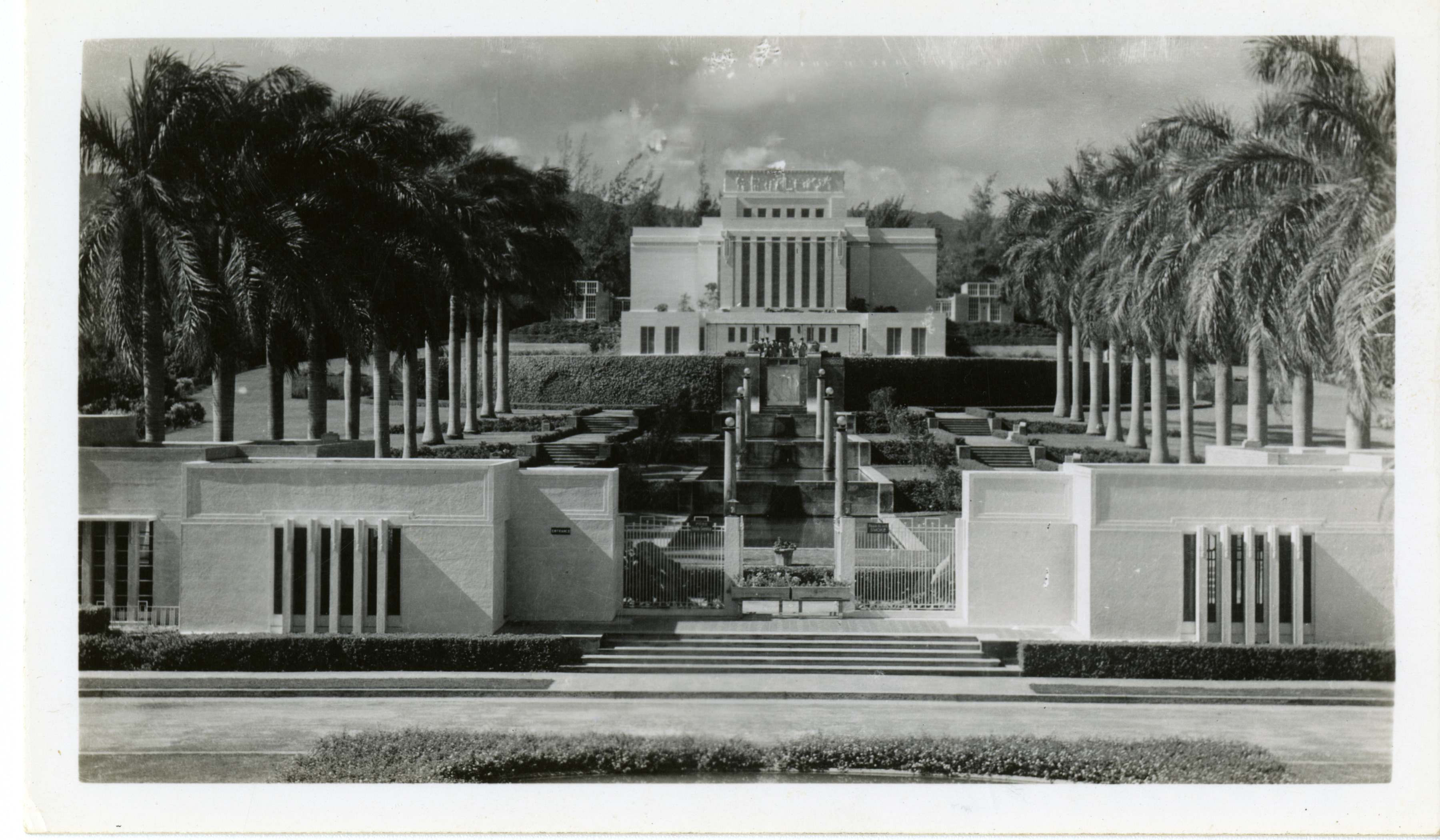


Beloved Iosepa
According to official LDS history, the first group of missionaries sent to Hawaii arrived in Honolulu on December 12, 1850. The next day they climbed a mountain and dedicated the islands (called the Sandwich Islands at that time) for the preaching of the gospel, George Q. Canon was among them.
.jpg)
I feel impressed to dedicate this ground...I have not presented this to the Council of the Twelve or to my counselors; but if you think there would be no objection to it, I think now is the time to dedicate this ground. (Quoted in The Laie Hawaii Temple: A History from Its Conception to Completion, by Richard J. Dowse, published by BYU in 2012)
Heber J. Grant would become the next LDS Church president, and he would dedicate the temple (on Nov. 27, 1919) in the absence of Smith. Remember, it is not always the architects who die in these narratives. Sometimes it is the Church leaders who envision the temple in the first place. In the case of the Salt Lake Temple, it was both Brigham Young and Truman Angell who died before the temple was completed and dedicated. In the case of the Hotel Utah, it was apostle John R. Winder (given charge of the construction of the building at 89 years old) who died one year before it was completed.
This pattern does not end with Smith, because although President Grant would announce plans for the Idaho Falls Temple in 1937, he would also tragically die before seeing that building dedicated, necessitating George Albert Smith to do it in his absence. Grant died on May 14 of 1945, and the Idaho Falls Temple wasn't dedicated until September 23, 1945.
It is significant that this pattern continued up until the end of WWII, because this is the time I believe that our civilization finally figured out how to construct new buildings that were more than primitive wooden shacks. I believe WWI and WWII were excuses to wipe out even more Old World architecture that survived the Worlds Fairs. If you're questioning my last statement, google the bombing of Dresden, Germany, and you'll get an idea of what was lost.
The temple site dedicated by Joseph F. Smith in 1915 was a sacred place to the Hawaiians, it was known as a pu'uhonau, or "city of refuge". It is said that ruins of ancient temples existed in the area. The Hawaiians called these places Heiaus, literally meaning "Hawaiian Temples."
This should beg the question: was the Laie Temple built upon the ruins of something more ancient? Or was it already there, founded, and claimed by Mormon missionaries visiting the Sandwich Islands in 1850?
The Ancient History of Laie
.jpg)
.jpg)
Moohekili heiau, the site of which is pointed out in the taro patches on the sea side of the Mormon Temple. The slight elevation of ground, the occasional sound of the drums, and the name, are all the traces that remain, according to the oldest Hawaiian of the district. (Quoted in Gathering to Laie, p. 5)
In my opinion, the Mo'ohekili Heiau and the Laie Temple are one and the same building. An ancient edifice that was already there when Mormon missionaries showed up in Hawaii in 1850. Although I cannot prove this theory indefinitely, I can show you that the construction story we are given is full of anomalies.
Another important point to make here is that the population of Hawaii plunged dramatically between 1778 (when Captain James Cook arrived) and 1860, falling from around 300,000 to 40,000. According to the official history it was mostly diseases, brought by the Europeans to the islands, that decimated the population. But what if it was something else? What if what we're told was "disease" was actually covering up a massive reset? What if the Hawaiians were killed by something, or someone else? And in losing so many native Hawaiians during that time period, what if they also lost the memory of their true history?
According to legend, these ancient heiaus were specifically constructed as sanctuaries for fugitives and outcasts:
Fugitives of all kinds - "men, women and children in war time, manslayers, thieves, and offenders against tapu (kapu) were allowed to enter the sacred enclosure, and once in, were safe. (Ibid, p. 2)
There are two other definitions of the name Laie that are worth mentioning here. These come from the book, Place Names of Hawaii. The authors of this book claim the literal meaning of Laie is the "leaf of the vine or plant." Others have claimed the name meant "The Day of Recognition."
I find the first name very interesting. "Leaf of the vine" could very well be referring to a remnant of survivors of some tragic catastrophe. Perhaps this was a war, famine, a natural disaster, or a ubiquitous reset.
Regardless of what happened, the video below provides further study into what the islands of Hawaii may have actually once been a part of:
A Brief History of Hawaii

The LDS Church in Laie
Brother William, this is the place we want to secure as headquarters of this [Hawaiian] mission. (Quoted in The Laie Temple: A Century of Aloha, by Eric-Jon Keawe Marlowe and Clinton D. Christensen, published by BYU in 2019, p. 34)
Supposedly, in this same vision, Young told Cluff that a future temple would be built in Hawaii. This account was not recorded until Samuel Woolley told the story in a 1920 conference talk, 56 years after the occurrence.
Hammond had a similar vision, claiming: "I saw President Young approach me. Said he, 'This is the place to gather the native Saints to.'" This account was supposedly recorded in Hammond's journal contemporaneously, and it later showed up in an 1896 article entitled, "The Sandwich Islands Country and Mission," The Contributor 17, no. 11.
Mr. Waterhouse, who held the mortgage on the plantation, came to foreclose, but agreement was reached avoiding foreclosure. To add to this gloomy situation (which was really more appalling than described above) the steam boiler broke down necessitating its removal and requiring installation of a new one, which work was done by Harvey Cluff at the close of 1874. (The Cluff Missionaries in the Sandwich Islands, p. 85)
In 1879, Harvey Cluff (William's brother) received permission from John Taylor to borrow more money from Waterhouse in order to construct a new sugar mill. Waterhouse allegedly told Cluff, "You can do nothing profitably, Mr. Cluff, without a new sugar plant. Go ahead and erect a new mill and I will back you up to the amount of $25,000" (Ibid, p. 90).
Something is not adding up here. Remember, the Church originally purchased (free and clear) the entire 6K acre property in 1865 for only $14,000. Somehow in the course of 14 years, they lost ownership of the property and then went into another $25K of debt for a new sugar mill.
Is this what really happened in Laie, or is this a cover story for something else?
Somehow, the Church acquired the property the temple sits on today, and (in my opinion) was given an ancient temple that would have been very sacred to native Hawaiians. So what is the real story here?
Regardless of what happened, it is important to mention who Henry Waterhouse was. In addition to being an enormously wealthy land owner on the islands, he was part of the infamous Committee of Safety, the group of 13 men who overthrew Queen Lili'uokalani and took over the Hawaiian government in 1893.
In 1887, these men formed a secret society called the Hawaiian League, and swore oaths to protect each other and keep their identities secret. The Committee of Safety solicited the help of American political insider, John L. Stevens, U.S. Minister to Hawaii, who covertly dispatched a small group of marines sent on the USS Boston in January of 1893. This allowed them to easily overthrow the Hawaiian Monarchy in a bloodless coup.
The LDS Church was still tied financially to Henry Waterhouse during the 1890s, and because of the tension between Hawaiian natives and "haoles" (pejorative term for white outsiders living in Hawaii), a statement was made by mission president Matthew Noall in 1894, in which he claimed, "...we have taken no part whatever in the politics of this county..."
But was that really true? We have a financial paper trail that is undeniable. Despite modern LDS claims of "political neutrality", the Church has given enormous support, both philosophically and financially, to the United Nations, an organization designed to destroy national sovereignty and individual liberty. Read this series of posts to learn more about that.
A Typical Prophetic Beginning
I tell you that there are people here today who if they continue in the work of the Lord, shall enter into the temple or temple; and the time will come, in my judgement, that a temple will be built here. (Quoted in The Laie Hawaii Temple: A History from Its Conception to Completion, by Richard J. Dowse, published by BYU in 2012)
The earliest known "prophecy" of a future temple in Hawaii was supposedly uttered by Elder John S. Woodbury in 1852. It reads as follows:
The Lord is well pleased with the labors of his servants on the islands and angels of the Lord are near us, that the people we're laboring among are a remnant of the seed of Joseph, and that they would be built up on these islands, and that a temple would be built in this land. (Gathering to Laie, p. 105)
Allegedly, this utterance was recorded contemporaneously in Francis Hammond's journal in October of 1852. However, most of the temple "prophecies" we encounter are backdated and often are not published until decades later.
Rather than attempting to disprove the legitimacy of these "prophecies," I think it better to compare them to the patterns we find in earlier church history in Kirtland and Nauvoo.
The Kirtland Temple was constructed in three years, between 1833 and 1836. The first known mention of a temple being built in Kirtland came in a revelation in September of 1832, only three months before plans for a temple were announced. This revelation was published abroad to all church members. The Lord simply stated the following:
For truly, this generation shall not pass away until a house shall be built unto the Lord and a cloud rest upon it... (T&C 82:3)
This statement did not come from some obscure, anecdotal rambling, reminisced by a second or third party claiming to hear and then subsequently publishing it decades later. This was contemporary, and published abroad for the entire LDS congregation, and local area in Kirtland.
The next mention of a temple in Kirtland came in the form of a direct commandment from God in June of 1833:
Truly I say unto you that it is my will that a house should be built unto me in the land of Zion like unto the pattern which I have given you. Yea, let it be built speedily by the tithing of my people. Behold, this is the tithing and the sacrifice which I, the Lord, require at their hands, that there may be a house built unto me for the salvation of Zion... (T&C 96:4)
And the Lord always caveats His commandments with a promise and warning, based upon the obedience of His people:
And inasmuch as my people build a house unto me in the name of the Lord, and do not suffer any unclean thing to come into it that it be not defiled, my glory shall rest upon it, yea, and my presence shall be there, for I will come into it. And all the pure in heart that shall come into it shall see God; but if it be defiled, I will not come into it, and my glory shall not be there, for I will not come into unholy temples. (T&C 96:5)
And we know that the Kirtland temple was the ONLY modern temple in which the Lord appeared. You can read Joseph's testimony of that occurrence here. It is also the most modest temple, and obviously not from the Old World.
In the case of the Nauvoo temple, we find a commandment also accompanied by a promise and a warning. And in this instance, the Lord's people failed to build the temple in the time appointed, which resulted in their being rejected as a church (congregation). Read the commandment and warning here.
If we compare and contrast these early patterns to later temples (after 1847), we find vast discrepancies.
We never see direct commandments from God to build these temples published contemporaneously before the LDS Church.
We often see backdated prophecies or utterances about a future temple being built which come from obscure, second-hand sources. And we never see promises or warnings coming directly from God specifically regarding these temples. They always seem to be finished miraculously, some in record time, and with exquisite workmanship that seems impossible for the time period.
And most concerning, we never hear of another account of the Lord appearing in any of these later temples, and this should be our biggest red flag.
The Strange Tale of Moving the I Hemolele Temple
Often times we find in these Old World Building narratives that a pre-existing structure was demolished or moved to make way for a "new" building. This is a very common pattern in these stories, with some buildings (especially capitol buildings and cathedrals) being the five or sixth structure "built" on the same site.
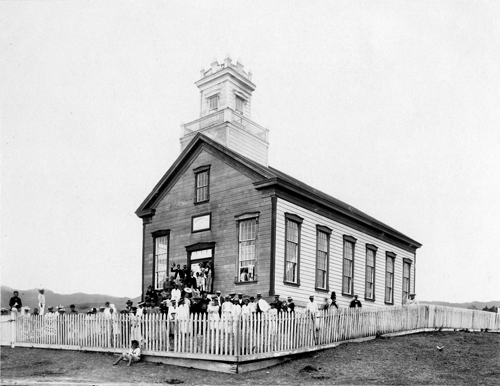
This building does not look like a temple, however, there are some legends surrounding it that allude to there being an ancient edifice on the site.
The LDS chapel and school, a three-room building about 90 feet by 30 feet, needed to be moved away from the Temple site. There were no trailers or trucks, nor any mechanical device to lift or move as large a building as the chapel. Finally under the direction of Brother Pope, of the Pope & Burton Architects, and under the foremanship of Hamana Kalili and David Haili, some twenty husky Hawaiians moved the building. First, they lifted the nine-ton building off its foundation with jacks and placed large timbers under it. Then they laid two rows of four inch pipe about three feet long on solid timbers under either side of the building. With tackles and long ropes the men pulled and pushed the building down the hill...Each time the building rolled off a pipe someone would pick it up and carry it ahead of the building and placed it on solid timber again to await the time when the chapel would roll over it. Pipes and timber were carried down the hill ahead of the building to make a continuous track on which the chapel was hauled. When it reached level ground, it was then hauled over to the spot where the present Laie chapel stands. It took many days to move the chapel and to set it up... (The Laie Hawaii Temple, p. 68)
How ridiculous does this sound? Can you imagine this cartoonish scene involving twenty husky Hawaiians heaving and hoeing a nine-ton wooden building with ropes while it rolls downhill on pipes? Of course, there are no contemporary sources to verify it. We do have a photo of men "moving" the building, however they don’t even look like Hawaiians and they aren't moving anything. Most of them are standing around, one man is crouched next to the foundation looking like he's scratching at something. We don't see the jacks, pipe rollers, or timbers (this is highly suspect, as there are no naturally occurring forests with large timbers in Oahu).
.jpg)
Scroll back up and look at the other photo of this building. Here is the same building ready to be moved, notice the fence and the lack of trees. These two photos have completely different surroundings.
Regardless of the authenticity of the photographs, the first time the world is aware of this story is nearly six decades after it supposedly happened.
Stranger still is this claim by former Assistant Church Historian, Andrew Jenson. Writing about the old chapel, Jenson states:
It occupies an elevated piece of ground and can be seen to advantage a long distance oft [sic]. It is known among non-members of the Church as the Mormon Temple--a distinction which it perhaps duly deserves, it being the finest house of worship on the island of Oahu outside of Honolulu. (Quoted in Ibid, p. 69)
Scroll back up and look at the building again. Nothing about it screams "temple" or “fine house of worship” to me. It looks like a glorified wooden shack. If this building was truly known by non-members as the "Mormon Temple" then it should've appeared more temple-like. Like, say...the building below:
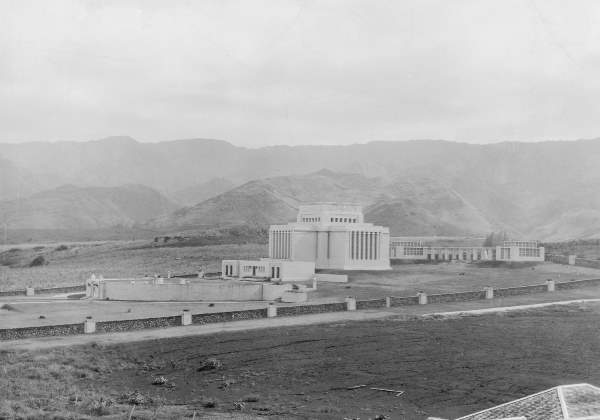
The old wooden chapel stood in the spot it was moved, we're told, until 1941. So unfortunately, we have no physical evidence that the building ever existed at all. The world was not informed about its being torn down until 1957, in an article published in the Hui Lau Lima News. The origin story of this chapel began and ended in the same year: 1957. Before that, no one ever knew about this wooden shack and the history it held.
Did it ever exist? Or is the structure that still stands in Laie today the real I Hemolele temple of refuge? Indeed, was it known even earlier as the Mo'ohekili Heiau? Isn't it strange that two other buildings were said to have occupied the temple site?
Let's move on to the anomalies involving the architects and builders.
Pope, Spalding, and the Woolleys
Hyrum C. Pope was born in Bavaria, Germany in 1880. He was baptized into the LDS Church in 1889 when his family was taught by missionaries, and he immigrated to Salt Lake City in 1896. He worked as an apprentice in an architecture shop in town, and after advancing to beginning draftsman he took a job in Chicago at an architectural firm. At the same time we're told that one of his hobbies was studying at the Chicago Institute of Architecture.
After returning to Salt Lake around 1911, he partnered with Harold W. Burton and they started their own firm. In 1912, the LDS Church held a design competition for a new temple in Cardston, Canada, and Pope and Burton were awarded the bid (design competitions are another pattern we see in these old building narratives). Ground was broken for the Cardston temple, we're told, in 1913, but the building was not completed until after the Laie temple was finished. We're told that Pope and Burton were also awarded the bid for the Laie temple.
The earliest known source for Pope's involvement with the Hawaiian temple is an article in the Improvement Era written by Pope himself in 1919. Read it here. Curiously, Pope never mentions that he was the architect who drew up the plans for temple, but is rather just describing the architecture itself. He does cite an earlier article written in 1916 by John A. Widtsoe, who similarly describes the building as if it had already been completed.
This is strange, because in September of 1916 (when the article was published) the temple was still under construction. Here are Widtsoe's remarks:
The temple is built in the form of a Greek cross. The so-called annex is built against and forms an integral part of the basement story of the east arm of the cross. The building is surmounted by a square room, over the centre [sic] of the cross, giving the effect of a truncated pyramid or tower. The roofs of annex, main building and tower room, are flat, on which it is planned to maintain flowerbeds...(See article)
Widtsoe never clarifies whether he is describing the building from a set of architectural plans, or from a physical view. But from his description above, it sounds like the building had already been constructed. Stranger still is the fact that Pope stated in his 1919 article that Widtsoe visited Hawaii in 1918, which creates another discrepancy in the account:
A most interesting article touching this was written by Dr. John A. Widtsoe in the September, 1916, issue of the Improvement Era, entitled, "The Temple in Hawaii a Remarkable Fulfilment of Prophecy." In this article Dr. Widtsoe, who, during the summer of 1918, visited the Hawaiian islands...(See article, emphasis added)
There are no records verifying that Widtsoe went to Hawaii in 1916, but there are some credible sources that document a 1918 trip. So how could Widtsoe write an article two years earlier in 1916 describing things he saw in 1918? Either he was a time traveler, or the narrators messed up on the timeline. Regardless, this is just one aspect of the Hawaiian temple story that doesn't add up. There are many more discrepancies to address.
Walter Spalding was an MIT trained engineer and building contractor who claimed to have built the Laie temple in 1916. He made these claims in an interview conducted by Max Moody (then temple president in Laie) in 1973, 57 years later.
Woolley: Now President Smith, you've arranged for the plans of the temple; who will we get to to build the temple?
Smith: Why, we'll have Ralph build it.
Woolley: But he's never even built a house!
Smith: Well, hasn't he got his degree? He's got his degree of course he can build it.
Romania claimed that Ralph was driving the car and later recalled:
If I hadn't been seated at that automobile with my hands on that wheel, I'd have fainted.
Romania then claimed that Ralph rushed to the library and read everything he could find on "building and construction."
No other sources verify this conversation. There is nothing contemporary proving that Ralph was hired as superintendent for the temple. His father Samuel was apparently an avid journal keeper, but his entries abruptly end in 1915, rather conveniently I might add, one year before we're told construction on the temple began. Samuel mentions nothing in his 1915 entries about Ralph being hired as superintendent.
Spalding claims that after he finished the concrete on the temple in late 1916, Ralph oversaw the remaining construction of the interior, the annex, outbuildings, and landscaping. There are no documents detailing any construction logistics on these later projects, only photographs and depictions showing a completely finished property with many outbuildings and concrete formations.


We're already off to a shaky foundation on the construction narrative of this temple. As we dive into the actual construction details, however, this shaky foundation begins to crumble.
The "Construction"
According to the book Gathering To Laie, ground was broken for the temple on February 8, 1916. Details describing the excavation were not known until 1957 in an article published by the Hui Lau Lima News. The work was claimed to have been accomplished using only "picks, hand shovels, blasting powder, and a mule-driven scraper."
Apparently, the ground below the temple was extremely porous coral rock, material not suitable to support the foundation of a large concrete structure. To remedy this, we’re told that workers had to dig down 15 feet in some places, to ensure the temple would sit on a solid foundation. After all the porous material and soil were extracted from the site, the workmen filled the hole with "large lava rocks and cement to form the thick and sure foundation."
(This is strangely reminiscent of the St. George temple foundation story. The AI writing this history often repeats itself, and we see similar themes across multiple narratives.)
There is no timeline given for how long the excavation and foundation took. And there is no record of a cornerstone ceremony, although Walter T. Spalding thinks he recalls there being one. His recollection wasn't recorded until 1973.
The only "proof" we have that the excavation took place is the photo below:

I see a few nicely-dressed men standing around, but no one seems to be digging. Remember, this is a hot, humid, and tropical place. Why would men dress in long sleeves, suits, and ties, just to become drenched in their own sweat?
The boards we see sporadically arranged in A-frames might be some primitive form of surveying equipment, but nothing in the photograph is explained to us. One thing is for sure, I see rocky ground that would have been very difficult to dig through with hand shovels and picks, even though steam-powered backhoes were commonly used during this time period.
According to the narrative, the entire building was constructed out of poured concrete, which Hyrum Pope described as:...a monolith of artificial stone, which, after thoroughly hardening, has been dressed on all of its exterior surfaces by means of pneumatic stone cutting tools, thus producing a cream-white structure which may be literally said to be hewn out of a single stone. ("About the Temple," Improvement Era, 1919)
This statement is interesting because this was the only instance in which pneumatic tools were mentioned. However, none of the construction photos show air compressors, hoses, or pneumatic cutting tools. Air compressors in the early 1900s were steam or electrically powered, and were a rare occurrence in rural areas, especially isolated islands. Pneumatic tools were more likely to be found in metropolitan areas housed in large industrial factories where there was plenty of room for massive steam or electrical engines.
In 1916, pneumatic tools were not generally mobile and used on job sites as they are today. Here is a photo of a typical compressor engine used in 1916:
.jpg)
This is not a machine that could be easily moved to a remote job site on an island in the middle of the Pacific ocean. According to what Spalding stated in his 1973 interview, it was an all day trip driving his overland car on red, muddy, dirt roads from Honolulu to Laie. He said he needed chains to go anywhere on the island in those days, and that most of the materials were shipped to the job site via the railroad:
The railroad carried most of the supplies from Honolulu and went all the way around Kaena Point to Laie, and beyond. Everything except the crushed rock and the Waianae sand was carried by the railroad. There was no way that a truck could even carry a good load over to the...Laie, in those days, it was like going to another island. (Spalding Interview, 1973, emphasis added)
Spalding was obviously lying in this part of the interview, because the railroad never actually reached Laie, let alone "beyond". The rails terminated at Kahuku sugar mill, three miles short of the temple site. And if Spalding couldn't even drive his car to Laie without chaining up, then how did workers load building materials onto trucks or wagons to make the final 3-mile journey on muddy roads? He said himself, "there was no way a truck could carry a good load" over to Laie.
There is no documentation of building materials being offloaded at Kahuku and loaded onto trucks or wagons bound for Laie.
Here is a map of the old railroad. Follow the red line. You can see it hugs the western shoreline and ends just as it crests the north shore:

Even if a compressor was shipped from the U.S. mainland and loaded onto a train at Honolulu, how did workers unload it at Kahuku and haul it the last three miles without heavy equipment?
As the author below describes, most accounts of the construction of the Laie Temple are painted as "miraculous":That the building of the Hawaii Temple could be achieved with such quality while using mostly unskilled labor in markedly remote conditions without the use of heavy equipment, be financed entirely in Hawaii, and be completed within two and half years despite various delays really was quite miraculous. (The Laie Hawaii Temple: A Century of Aloha, by Eric-Jon Keawe Marlowe and Clinton D. Christensen, p. 130, emphasis added)
If an air compressor was used on the temple construction site we do not have photographic or documentary evidence of this occurring. All we have is the statement from Pope made in 1919, two years after the tool would have been used.
But the pneumatic tool conundrum is not the smoking gun evidence that the Laie temple was pre-existing. The best argument against the LDS Church actually constructing this building manifests in the way the narrative describes the concrete work. We're told that Walter Spalding specialized in constructing buildings made of reinforced concrete, but as I'm about to show you, either he was grossly incompetent, or the whole story of the temple construction is a fabricated lie, made up out of whole cloth.
To come to this conclusion, all we have to do is a little forensic study of the construction photos. The anomalies in these photos show us everything we need to know. But first, a statement from Samuel E. Woolley:
We are getting along nicely in the construction of the Temple. [We] have about 40,000 feet of lumber set up in forms ready for the pouring of concrete...(Quoted in, The Laie Temple: A History from Its Conception to Completion, Richard Dowse, 2012, p. 79, emphasis added)
This comes from a personal letter from Woolley to Joseph F. Smith, and it is one of the rare contemporary documents in this narrative, written in June of 1916. However, I believe it was created later and backdated. It does, after all, come from LDS Church History Archives, not a place I trust for accurate historical documents.
But my speculation on the origin of the letter is not the problem here, the problem is what the letter says. When constructing an entire building the size of the Laie Temple out of poured concrete, you would not have 40,000 feet of lumber set up in forms at the same time. This is not the way concrete buildings are constructed, especially with the methods available in 1916.
We're told that the entire building was framed in concrete, including the foundation, walls (both interior and exterior), floors and ceilings, and roofs. A concrete building of this size and scope cannot be poured all at the same time, as that would be a physical impossibility.
Forms have to be constructed for every cubic inch of concrete poured for the building. This would've begun with the foundation and basement walls, then slowly progressed to the main level, beginning with the main floor and walls, then moving up to the higher levels, eventually ending at the roof. Each stage would require building forms out of lumber, pouring concrete, letting it cure anywhere from several days to weeks, then disassembling the forms, and, using the same lumber, constructing new forms in different specifications, pouring new areas of concrete on top of cured sections, etc.
This cannot be done all at once. The concrete poured on the lower levels has to cure for a certain amount of time before it is sufficiently strong enough to hold the weight of freshly poured concrete structures on top of it. Loadbearing concrete has to be incredibly strong and cured correctly or the structural integrity of the entire building can be compromised.
There may well have been 40,000 feet of lumber on the job site, but this would never have been set up in forms all at the same time. This is a massive red flag in the narrative.
Exterior and loadbearing walls of concrete buildings are poured incrementally in what are called "lifts." A lift is a section of concrete wall that is poured simultaneously and allowed to cure before the next section is poured.
In the early 1900s, concrete wall lifts were typically anywhere from 2-5 feet high. Before the lift could be poured, wooden forms were constructed to exact specifications and then squared and plumbed to ensure wall straightness. After the forms were sheathed (meaning that liquid concrete had nowhere to escape during pours) and braced with crosspieces called "walers," the concrete was then poured and allowed to cure. Then, after the concrete was sufficiently strong, the forms were disassembled and reused for the next lift.
This was tedious and time-consuming labor, as each lift required constructing forms that varied in dimension and specification. This would've required skilled carpenters, because even if a single level of wall forms was constructed out of square, the entire building would be compromised. Yet, we're told that the laborers who worked on the Laie temple were unskilled in both carpentry and cement work. According to Walter Spalding:
Mr. Woolley...had at that time something like five hundred Hawaiians, mostly full blooded Hawaiians, working on the sugar plantation that belonged to the Church and he wanted me to use these men. Most of them had no trade. They were neither carpenters nor cement workers or plumbers or anything of that sort, very few. (Spalding, 1973 Interview, emphasis added)
How did unskilled laborers frame a monolithic concrete temple to exact specification in only 13 months? We are not given contemporary documentation detailing how they achieved this feat of construction. Everything we're given is backdated by decades. The only "evidence" we have are construction photos, so let's analyze them.
"A Monolith of Artificial Stone"
When Hyrum Pope, the temple's supposed architect, described the building in his 1919 article he declared that it was "a monolith of artificial stone." The definition of monolith is "a geological feature consisting of a single massive stone or rock." This means that the entire temple was framed out of concrete, including the roof. This was not an easy task in 1916. In fact, according to historians, monolithic concrete construction was a relatively new practice during this time period and required highly specialized training. This was not something an amateur builder could meddle in.
According to the account, this is why Spalding was hired for the job. He supposedly had this kind of training. However, he was rarely at the job site, and left Ralph Woolley in charge, a man who had never built anything. Worse yet, he left Ralph to construct the building with unskilled plantation workers. According to his 1973 interview, Spalding said he was lucky to make it out there once a week to check on the construction.
As stated before, details about Walter Spalding, Ralph Wooley, and the plantation workers did not surface until decades after construction. So as far as contemporary evidence goes, all we really have are construction photos. Unfortunately, there are only a few available. Let's take a look at them.

There are several anomalies in this photo, as I go through each one, I recommend zooming in on the image.
Let's start with the tower on the right. Notice the half-pipe looking chute protruding from the tower. I think this is supposed to be a concrete chute, however, if you attempt to follow it down to the top of the building it disappears behind the man appearing to be leaning over the edge. If this was used to pour concrete, then how was mixed cement hoisted up to the top of the tower and poured down the chute? We don't see any buckets, ropes, pulleys, or derricks in place for hoisting mixed cement. We don't see how the chute extends to reach all parts of the building and we are not allowed to view the platform at the top of the tower.
We see two derricks on top of the building but they don't seem to be serving any function. Notice the men at the top of the building. This is a hallmark of these old construction photos, there always seems to be men on the top level of the structure posing in strange positions, as if they were children playing on a jungle gym. Then we have the workers at the ground level doing absolutely no work and appearing in posed positions and nice clothing. Where are the shovels, wheelbarrows, buckets, and other implements used to mix cement?
Now take a look at the wooden forms that extend all the way to the top of the building. This is not framing, the building is already framed in concrete. These are concrete forms that have been made to appear like framing. When I show the next photo, we'll go over all the problems with these forms.
Now look at the sand area on the right side of the image. The sand appears to be drifting and almost swallowing up the bottom of the wooden ramp at the bottom of the tower. Now follow the sand down to the rock pile towards the bottom, and up to where it disappears behind the right side of the building. There is something wrong with this sand, it does not appear to be a natural background in this photo. The transition lines where the sand disappears look too abrupt to be natural lines. I believe the sand has been photoshopped in (perhaps to illustrate that this building was being constructed on an island). Also notice the skies, they are almost always dark, dreary, grey, and anomalous in these old construction photos.
Now look at the lower part of the building that looks like it has a creamy, white finish. The official account says this about the finish:Hence, the building is a monolith of artificial stone, which, after thoroughly hardening, has been dressed on all of its exterior surfaces by means of pneumatic stone cutting tools, thus producing a cream-white structure which may be literally said to be hewn out of a single stone. (Pope's 1919 article in the Improvement Era)
I'm not sure how rough concrete can be shaped with some kind of air tool (we're not told which kind) and produce this finish without adding some other kind of plastering material to its surface. But if you scroll back up to the photo you'll notice that the finished areas stick out past the concrete, so the concrete has been added to, not cut with air tools.
However, the strangest part of the image is the transition you see from the lower finished area to the rough, upper concrete. Notice the area below circled in blue:

Strangely, the framed-in forms appear to curve around the finished part and continue downward. This makes no sense at all; you would not need wooden forms around any part of the finished area; they are serving no logical purpose. Furthermore, why would you waste labor and resources to cut boards like this to frame around a curved ledge? Before any facade work is done, the form lumber would've been taken down. Also notice how the lumber lines become blurry towards the bottom of the facade. This doesn't make any sense.
Here is the finished temple. Do you honestly think this is the same building portrayed in the construction photo?
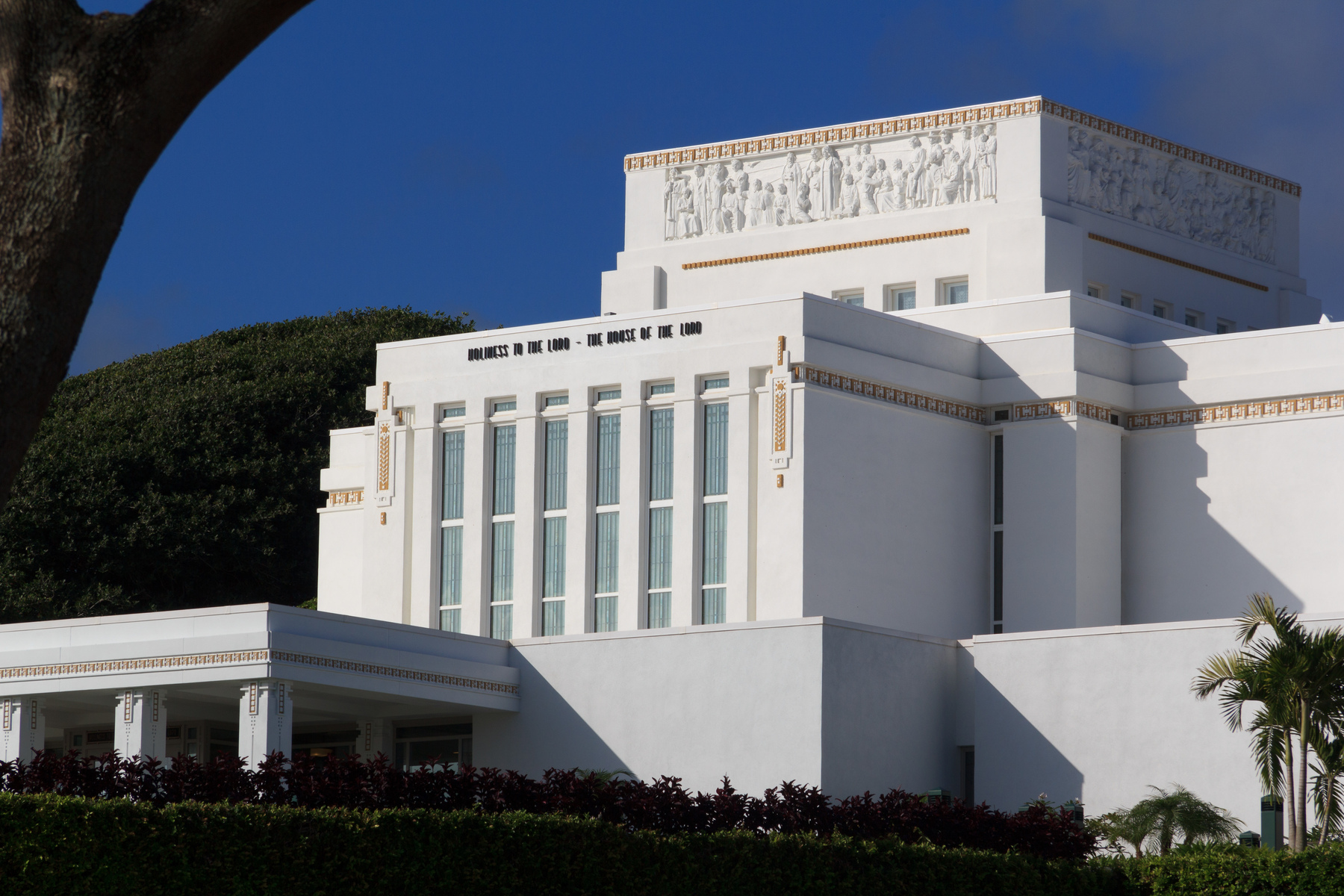
Finally, why wouldn't you wait to complete the facade of the building until after it was completely framed and roughed-in? Facades are usually done all at once at the end of the building project using scaffolding, ladders, and lifts. Professional contractors do not construct buildings the way that is portrayed in the first photo.
Let's move onto the next "construction" photo.

We see basically the same scene in this photo but with some slight nuances. However, these variations contain red flags and subtle clues that lead me to conclude that these photos were staged. First of all, this appears to be a later photo because the height of the left tower is higher and the framing on the right tower is extended.
Remember, this is form framing, not structural framing. It is also known as concrete falsework. Forms are only used to give the liquid concrete a container to set up in. Once concrete is cured the forms are taken down and used again later. The forms in the photo above are not completely built concrete forms. They appear as merely a skeleton on the outside of the building. They would not hold any liquid concrete. They need walers, ties, sheaths, and bracing added in order to complete the forms. And they would only be between 2-5 feet high.
For comparison, here is an actual concrete wall form that has been freshly poured:
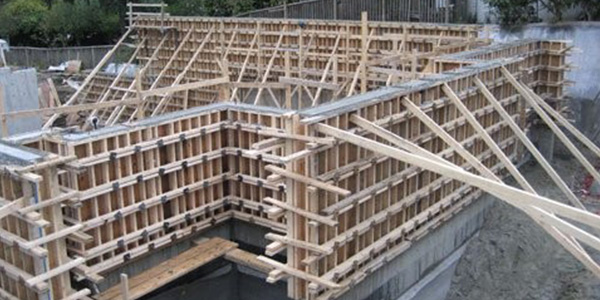
As you can see, there is nowhere for the liquid concrete to escape, and the walls are framed squarely and solidly. This is a professional concrete job. Why can concrete only be poured in short lifts and not all at once?
There are several reasons. For starters, liquid concrete is extremely heavy, and exerts heavy sideways pressure on the forms as it is poured. The deeper the pour, the more pressure is exerted. If the wall forms are too high, there is a much greater chance for leakage and blowouts to occur. Also, concrete has to be worked considerably as it is poured, and this is much more manageable when the pour is shallow.
Remember, we're told there was no heavy equipment used on this temple, so concrete had to be worked with basic tools and primitive implements. Sticks of lumber were used for "rodding", or poking repeatedly into the wet concrete to get it to settle at a uniform density. This was done to eliminate air voids that would cause weaknesses in the walls. It also had to be tampered (compacted after rodding) and leveled to the top of the form with a trowel. The lift area had to be perfectly level before the curing process could begin.
If the concrete was poured too fast or too deep (this could happen if the lift area exceeded 5 feet) then it could cause honeycombing, which means that voids or air pockets would form in it. If honeycombing occurred while pouring a deeper wall, workers may not have had enough time to properly "rod" the concrete before it began to set up. This is why smaller lifts (2-5) were typically employed, as they made each pour much more manageable.
Another reason why smaller lifts were used during this time period is because of the painstakingly slow process of mixing concrete. In isolated areas like Laie, concrete had to be mixed by hand in wheelbarrows or buckets (although Spalding mentions that there was a concrete mixer on site, but can we believe an account published 73 years later?; also there are no photos of this supposed mixer), and then hoisted up to workers on the walls with ropes, pulleys, and derricks. If cement workers on the walls had to wait too long for mixed cement to reach them, then the pour they were working on would begin to set up prematurely, causing potential problems for the structural integrity of the building.
There were many variables that workers had to deal with when attempting to construct an entire building out of concrete.
Do you really think this would've been possible with workers who had zero experience in carpentry and concrete work? And in 13 months no less?
Before we go back to photo anomalies there is one more thing to address: concrete joints. If concrete is poured in small sections, one at a time, then you're going to have joints. There are two types of joints in concrete: planned and cold.
A planned joint makes a nice, clean, stopping point. A cold joint is an unplanned stopping point caused by concrete setting up too fast, problems with forms, or cement not being mixed fast enough. Each type of joint leaves marks on the rough walls of the cured concrete. However, in the "construction" photos of the Laie temple, we see no joint marks at all, which is another red flag. Here is a close up of the rough concrete:

Now for the smoking gun...
Not only are there no joint marks, we're actually not looking at poured concrete in this image, what we are looking at is block work that resembles stone masonry. We see both horizontal and vertical lines in the stone in that old brick pattern so familiar to us. Also notice the inconsistency in color. Some of the blocks are darker than others and we see considerable shade variations. Concrete does not behave this way, this looks much more like quarried stone. So what building are we actually looking at here? Certainly not the Laie temple claimed to a monolith of concrete.
A few more anomalies:

Take a look at the small ladder that's circled in blue on the upper left. It appears to be part of the formwork but disappears completely inside the finished "cream" area of the building. That doesn't make a lot of sense.
Now look at the area circled in red just to the right of that little ladder. We see a strange black hole in the corner of the building. Up and to the left of the little ladder we see another black hole, although much smaller. Was there really a black mass in the corner of the building or is this photo manipulation gone awry? This anomaly is located right at the transition point between the rough and finished areas of concrete, which may suggest that photographers were attempting to combine two negatives into one image.
Also notice that the form framing just above the black hole is, like the little ladder, also on the outside of the cream finish. This framing would not need to be there. The cream finish was the final exterior facade, and in normal construction processes, facades are not even begun until the entire exterior of buildings are roughed-in and completely built. Facades are decorative only, and have nothing to do with the structural integrity of the building.
Why would you begin to facade a building while simultaneously attempting to complete concrete pours at multiple story heights?
Think of all the tools and equipment that you would need to move up and down that could potentially damage the freshly finished facade. This is not a practical way to construct buildings.
Let's look at another angle of this image:

The man circled in blue doesn't seem to fit in the image. His legs seem to disappear into the concrete just below his knees and it looks like he was drawn into the image. The shading on the rectangular windows behind him does not appear natural and his body looks out of proportion.
And what about that tree? Why would this random tree be right in front of the building and in the way of construction? Wouldn't this tree have been removed at the time of excavation? If you scroll back up to the excavation photo, the tree is missing.
Let's look at a few more "construction photos":

We see a basically finished structure with what appears to be scaffolding. The men in the lower front seem to be handing bags of concrete, however, it looks like all the concrete has already been poured.
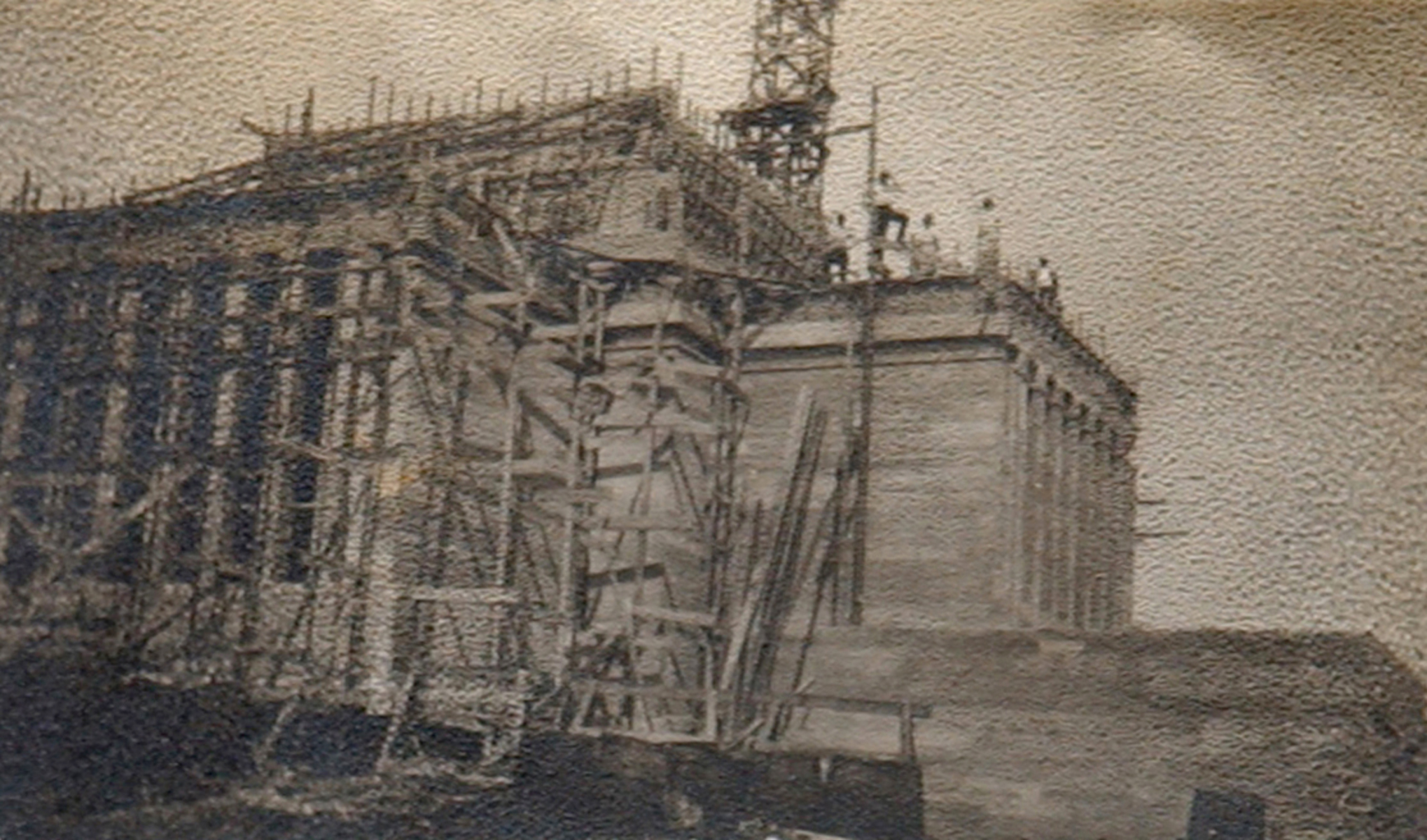
This one looks more like a rough drawing than a photograph. I'm not sure what those guys are doing up there on the roof. The exterior of the building looks totally finished.
Below is an old photo of the finished structure before any remodels were done.

What do you think? Is this the final outcome of the construction portrayed in the photos above?
More importantly, was the Laie temple actually constructed of quarried stone blocks and did the LDS Church merely find it and plaster over the outside of the building and have artists sculpt the friezes at the top? If so, why would the Church make up a story about constructing a concrete monolith?
Or, was the building found exactly as shown above, and simply renovated and repurposed as a temple? From the lack of documentation on the construction of this building, it's safe to say we'll never know what actually happened.
Concrete Ceilings and the Lack of Steel Rebar
Another important thing to think about when it comes to buildings framed in all concrete is how concrete floors and ceilings are actually constructed. This is not a walk in the park, especially for "unskilled" laborers. Unlike concrete walls, floors, ceilings, and roofs have to be poured all at once. In addition, they require much more extensive formwork with scores of pillars (usually made of wood or steel) placed in close proximity to hold up the ceiling as it cures.
Watch this 1 minute video to see how this is done today:
This video is worth a thousand words. Construction, believe it or not, it actually difficult to describe with written words, but it all comes together when you can see how it is done with your eyes.
Notice how extensive the formwork is in the video. Each floor of the Laie temple would've required large timber beams (2x6 or larger) running all the way across the walls or foundation. These needed to be leveled and supported with cross beams and pillars. If the pillars were made of wood they would've needed to be larger in diameter (4x4 or larger). Once the frame was completed, the entire top was covered with planking so that the freshly poured concrete would not leak through.
Now for the most important part: steel rebar. In the video we see extensive rebar laid out in a square grid across the entire pour area. This is called concrete "reinforcement." Rebar is also required in concrete walls, but floors and ceilings need exponentially more steel to meet structural load requirements.
Not only do we not see any rebar or steel in the construction photos of the Laie temple, we have no record of any steel being imported to Hawaii, shipped on the train to Kahuku, and then hauled on trucks or wagons to the temple site. We have no documentation or paper trail showing steel receipts. We don't know how much was shipped, what it cost, or where it came from, or how it got to the construction site.
This is important, because without steel reinforcement, the Laie temple wouldn't have lasted a decade, let alone 100 years. The only reference to steel being used in the construction comes from Pope, who stated:...it was therefore finally decided to build the entire edifice, floors and roofs as well as the walls of cement concrete, reinforced with steel in all directions. (The Laie Hawaii Temple: A History from its Conception to Completion, p. 89)
A single statement doesn't prove anything without a paper trail of documentation. How do we know we are being told the truth here? Where are the steel receipts? Where was it manufactured and shipped from? Were there delays? How much did the Church pay for the steel? These are valid questions that merit answers, yet we can find no documentation.
The Lumber "Miracle"
It wasn't until 1970 that the world first heard the faith-promoting "Lumber Story" associated with the Laie Temple construction. It was told by Romania Woolley, the wife of the late Ralph Woolley, the supposed superintendent charged with the construction of the temple. Romania doesn't give us an exact date of this miraculous occurrence, but other sources (i.e., interview of Viola Kawahigashi in 1990) claim it took place in late 1916, or early 1917.
The United States entered WWI in April of 1917, but the war had been raging in Europe since 1914. This put a damper on supply chains, and consequently, there were shortages on building materials. Hawaii faced two problems when it came to lumber: there wasn't much on the island that could be used for structural construction, and it sat in the middle of the Pacific ocean, isolated from civilizations by thousands of miles.
As the story goes, when the temple walls were about half way up the workers began to run out of lumber, to the point that they would have to halt progress on the temple. According to Romania Woolley, this is what happened:...at this point, [Ralph Woolley] was desperate. He climbed up...in the steeple of the belfry of the old Laie church...and pled with the Lord. "Tell me what to do. Where can I get some lumber?"...oh about two days passed, and he heard a commotion in the village--people were running to the sea... (The Laie Hawaii Temple, p. 85)
Supposedly, the people were running to a freighter run aground on reef close to Goat Island. This ship was full of lumber, and when Woolley told the captain how desperately the Church needed it, he said, "you can have all the lumber you want for nothing, if you can get it off the ship."
Then apparently, Woolley organized groups of swimmers from among the locals and all the lumber was "swam" to the shore and hauled up to the temple site.
There are, obviously, several problems with Romania's account. For starters, we have no contemporary documentation this event ever took place--no missionary journals, newspaper articles, Church documents, nothing. Secondly, freighter ships did not then, and do not now, cruise anywhere close to the reef on the north shore of Oahu. Many freighters came from San Francisco and followed a direct nautical route to Honolulu, which is on the southern side of the island. No freighter captain would have risked taking the northern route. Also, there are no official reports of ships running aground near Laie between 1915 and 1919.
There are, however, other people who claimed to have witnessed this event: Viola Kawahigashi and two other women interviewed in 1990 (73 years later), and Gus Kaleohano, interviewed in 1970. But again, nothing contemporary. Can we trust oral testimony of events that took place 5 to 7 decades earlier?
The other problem with this story is the sheer irony of it. But the time that freighter ran aground, if it ever did, there would have been no further need for form lumber, because according to other accounts, they already had about 40,000 lineal feet of lumber by June of 1916.
Earlier in this post I quoted a letter from Samuel Woolley, who stated that they had 40,000 square feet of lumber already set up in forms ready to pour concrete. This was in June of 1916, 6 to 9 months before the supposed ship wreck.
And if we look at this story with just a little common sense, we realize that 40,000 square feet would have been more than enough lumber because when pouring a concrete building it is done in stages, and form lumber is taken apart and reused over and over again.
When Walter Spalding was asked about Romania's claim of the mysterious lumber ship, he said he did not recall that instance but that it could've been arranged with Mr. Woolley. More specifically, he said, "I can't say that I remember that," followed by this curious statement:
...for form work you have to have...mostly one inch lumber and two by fours, and uh...most of the shipping of lumber down here in...on...on sailing boats in those days was in larger dimensions which were sawed into whatever sizes were wanted in the market in Honolulu. So...it...uh...there wasn't any way of cutting those...that lumber into the sizes needed for formwork...over at Laie, that I can think of. I mean there wasn't any existing except as the...might have been the Kahuku plantation had some kind of saw mill. (Spaulding Interview, 1973)
Obviously, the lumber miracle story is bunk--even if the Church was given free lumber and workers somehow swam it ashore, they had no way of cutting it to size.
Spaulding's comment about 1" lumber and 2 x 4's is also telling. In order to build complete forms you need studs, walers, ties, braces, and sheathing. Walers and ties could be made from 1" cleating and 2x4s, but Spaulding mentions nothing about sheathing: full sheets of lumber that needed to surround every bit of poured concrete. They would have needed several bunks of sheathing to construct the Laie temple, yet we don't hear a word about this material.
We see an illustration of a typical concrete form below, notice the sheathing occupies the largest portion of the form:
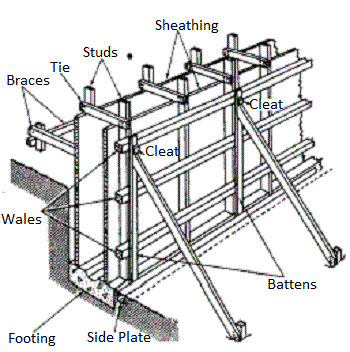
Spaulding also said that building materials "to finish the woodwork" were ordered as early as January of 1917. So again, if there was a lumber miracle ship, it would've come too late.
We could also ask if the lumber from the freighter was used on the interior finish of the temple. But according to official history, this wood was native Koa wood, known to rival "the choicest mahogany," and found all over the island of Oahu.
The Interior
In the 1973 interview, Spaulding was asked if he had gone through the inside of the temple prior to the dedication in 1919. He said that in 1919 he was in France fighting in WWI, but before he left for Washington in March of 1917 "some of the interior and mural paintings were done", but that construction "had not yet been fully completed."
Then, on the next page he contradicted himself, when he was asked by Max Moody if construction was "fully completed" by the time he left in March of 1917, he replied, "oh yes, fully completed." So did Spaulding actually see the completely finished interior or not?
If Spaulding's latter statement is true, then this means that the building only took 14 months to completely construct, from foundation to finished interior (from January of 1916 to March of 1917).
Spaulding also mentioned that it was "quite probable that Ralph Woolley built the auxiliary buildings and walks" because he didn't recall seeing those completed until he got back from the war.
And this is all we get for logistics on the interior and auxiliary buildings. No mention how many workers labored on the interior, what their skills and qualifications were, whether they were the unskilled natives who poured the concrete or skilled craftsman hired after the exterior was completed.
We get no documentation or financial receipts proving the purchase of the Koa wood or marble used on the interior. All we are told is that "most of the materials used in the construction of the building had to be imported from San Francisco, which many times caused delay." This was stated by Rudger Clawson, acting President of the Quorum of the Twelve Apostles in 1919 when he made this statement.
If these materials were many times delayed, then how did they completely finish the building (including the interior) in only 14 months? Why are there no contemporary journals describing this work? Why are there only oral stories, traditions, and folklore that tell us the story of the Lai temple?
When it comes to the finish work on this temple, the most documentation we have are on the art murals and sculpted friezes. This is typical of other Old World buildings, and I believe that the LDS Church actually hired artists to do this work on an existing building. Here is an early photo showing scaffolding up to the friezes:
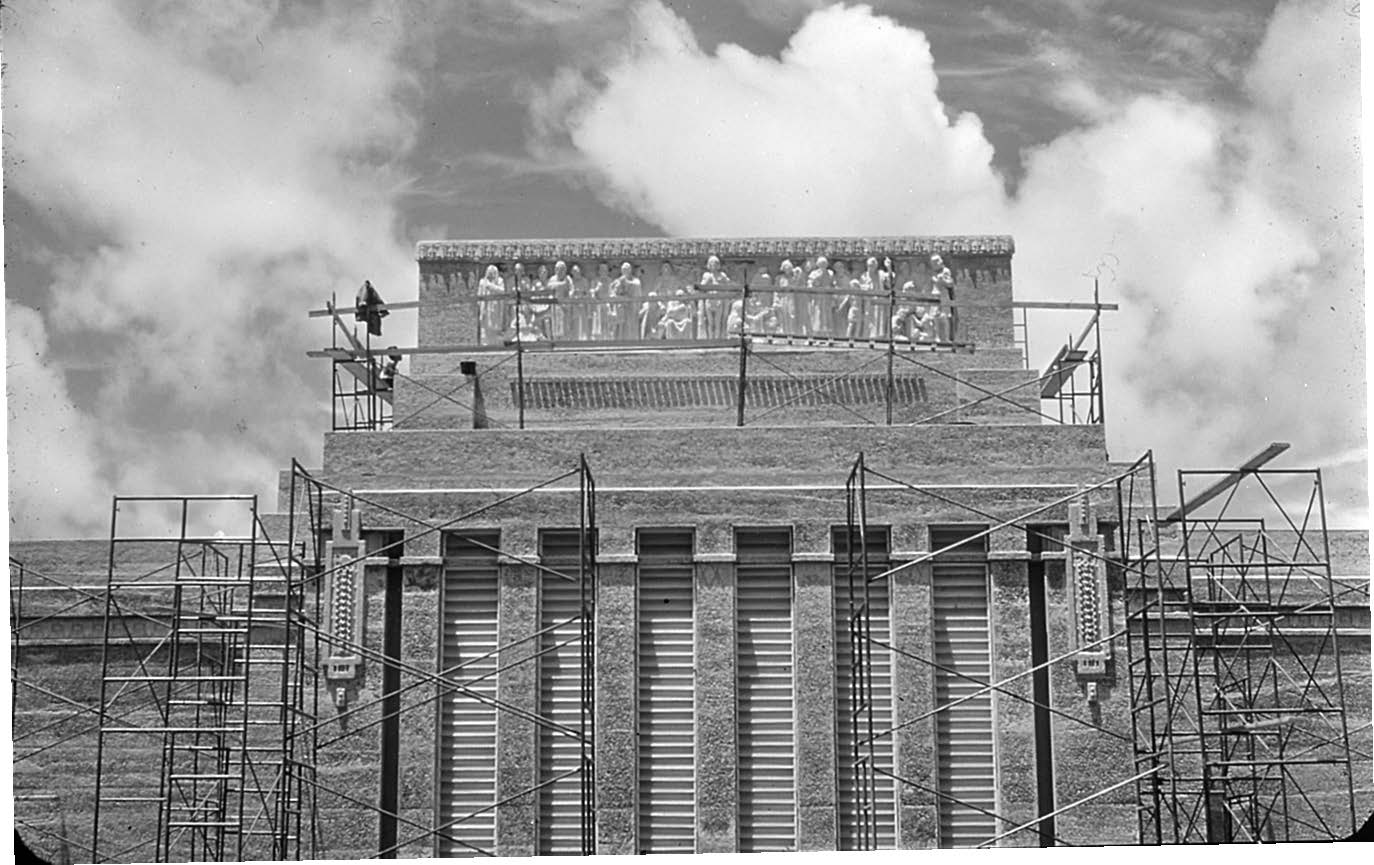
This photo is real, not staged or manipulated. Notice the skies, they look natural and clear, showing real clouds. Notice the clear resolution of the building and scaffolding. Contrast this with the earlier "construction" photos I shared. The difference is stark. Look at the facade of the building, it looks really old and weathered, not brand new as it should've been in 1918-1919 when this photo was taken.
These friezes were sculpted off site and shipped to the temple site. They were hoisted up in six-foot-wide pieces and installed at the top of building. They show different phases of Church history, including Book of Mormon depictions and even Joseph Smith's first vision. I believe this part of the story is absolutely true, read about it here.
The Laie temple has undergone a few renovations since the dedication in 1919. This photo of the baptismal font is one of the rare ones pre-dating the renovations:
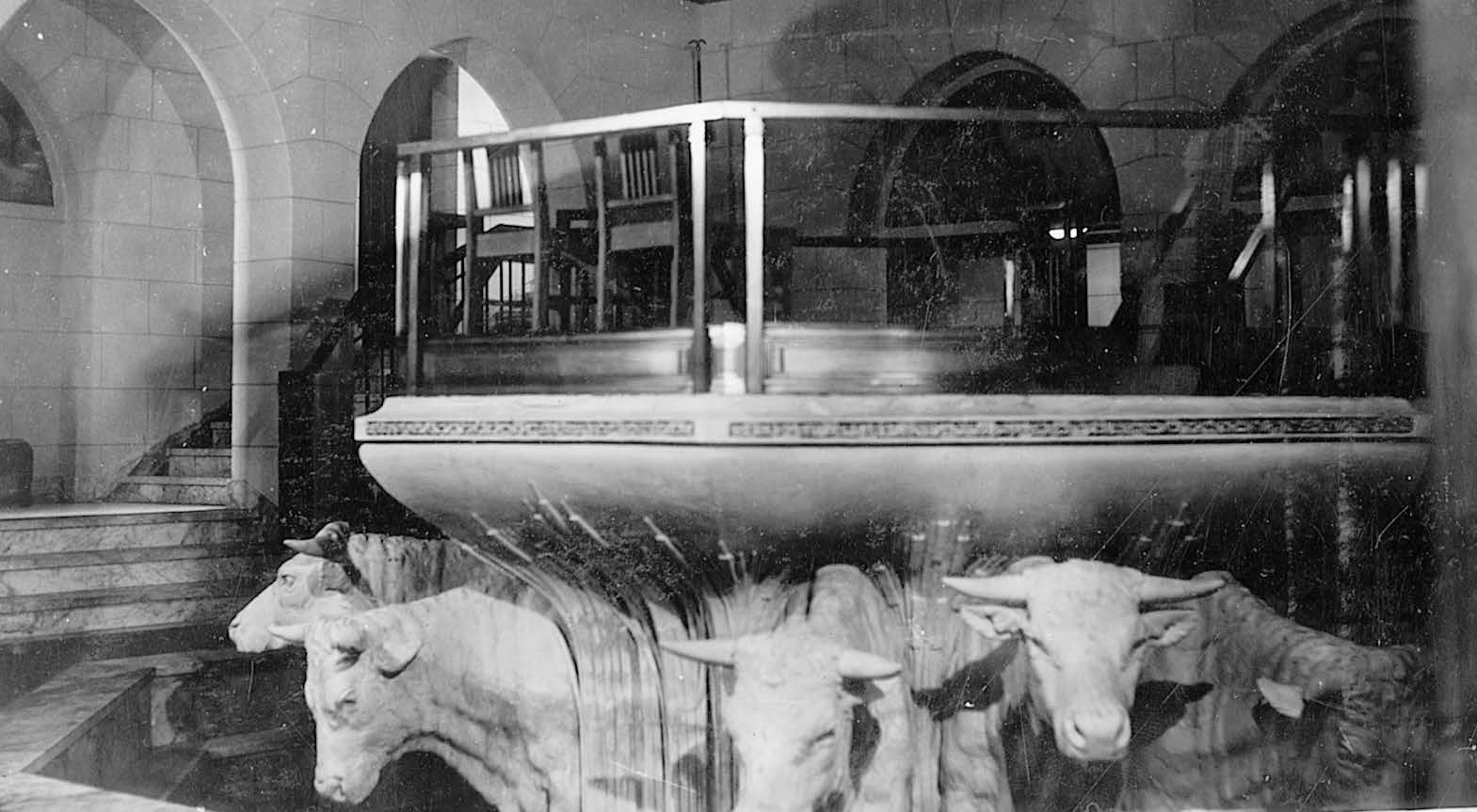
Take a look at the marble floor and stairway. Notice the workmanship. Do you really think this kind of work could've been accomplished by unskilled workers in only a matter of months? Look at the arches and what appears to be stone block work. Are those real blocks, made of granite or some other stone, or is this poured concrete with decorative masonry joints etched into them?
How difficult would it have been to build concrete forms that could accommodate arches? We are told nothing about this in the narrative. If those blocks are actual stone then where was it quarried, cut, and carved? Where was it shipped from? There are no granite quarries in Hawaii so it obviously was shipped overseas.
Here is another shot of the arches in the baptistry:
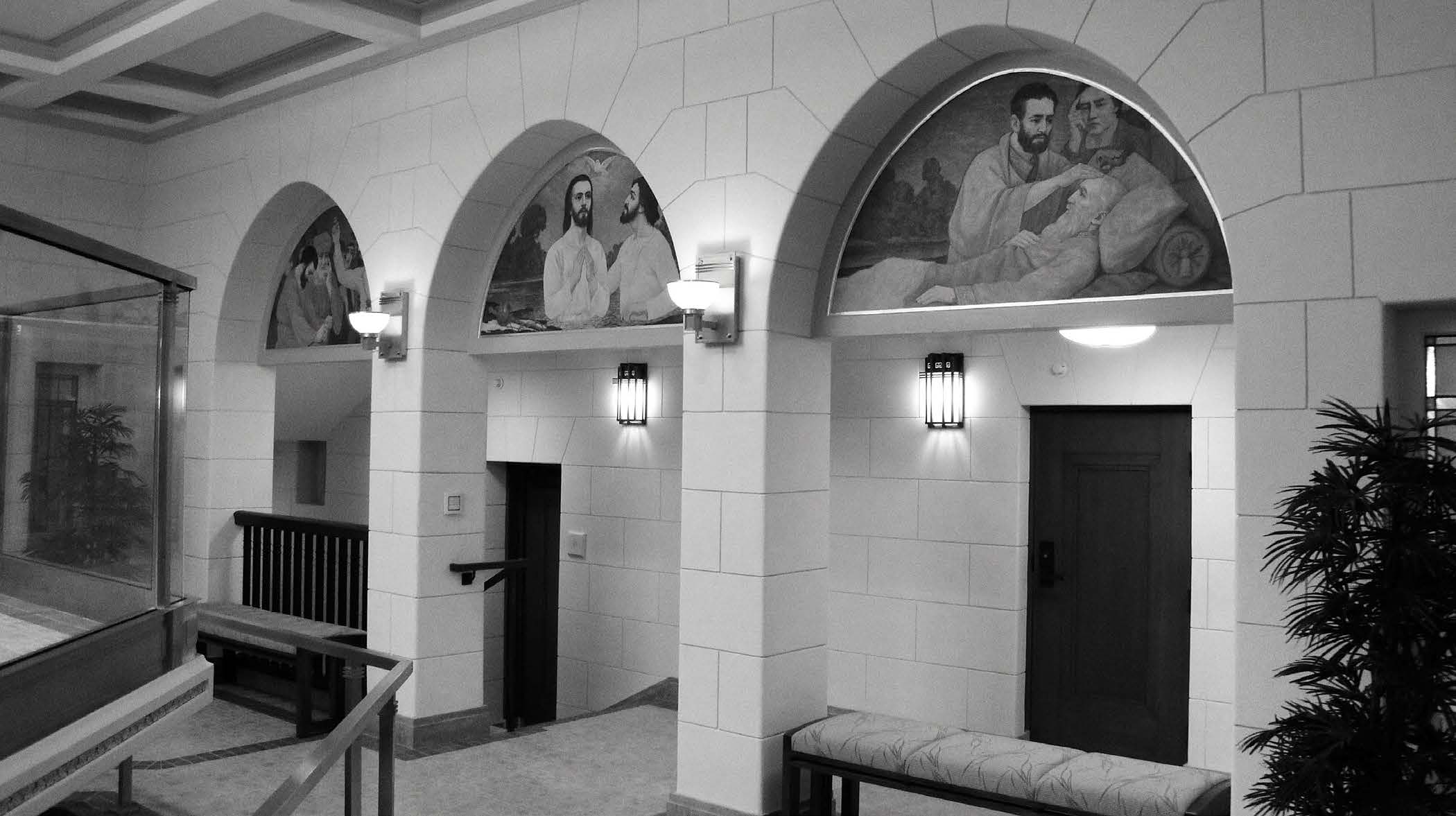
What do you think: stone blockwork or decorative concrete? Whatever it is, we're not given any logistical details about the work, including who actually did it.
Here are some other photos of the interior, but they are most likely post-renovation. The temple has been through two renovations (1976-78 and 2008-10):


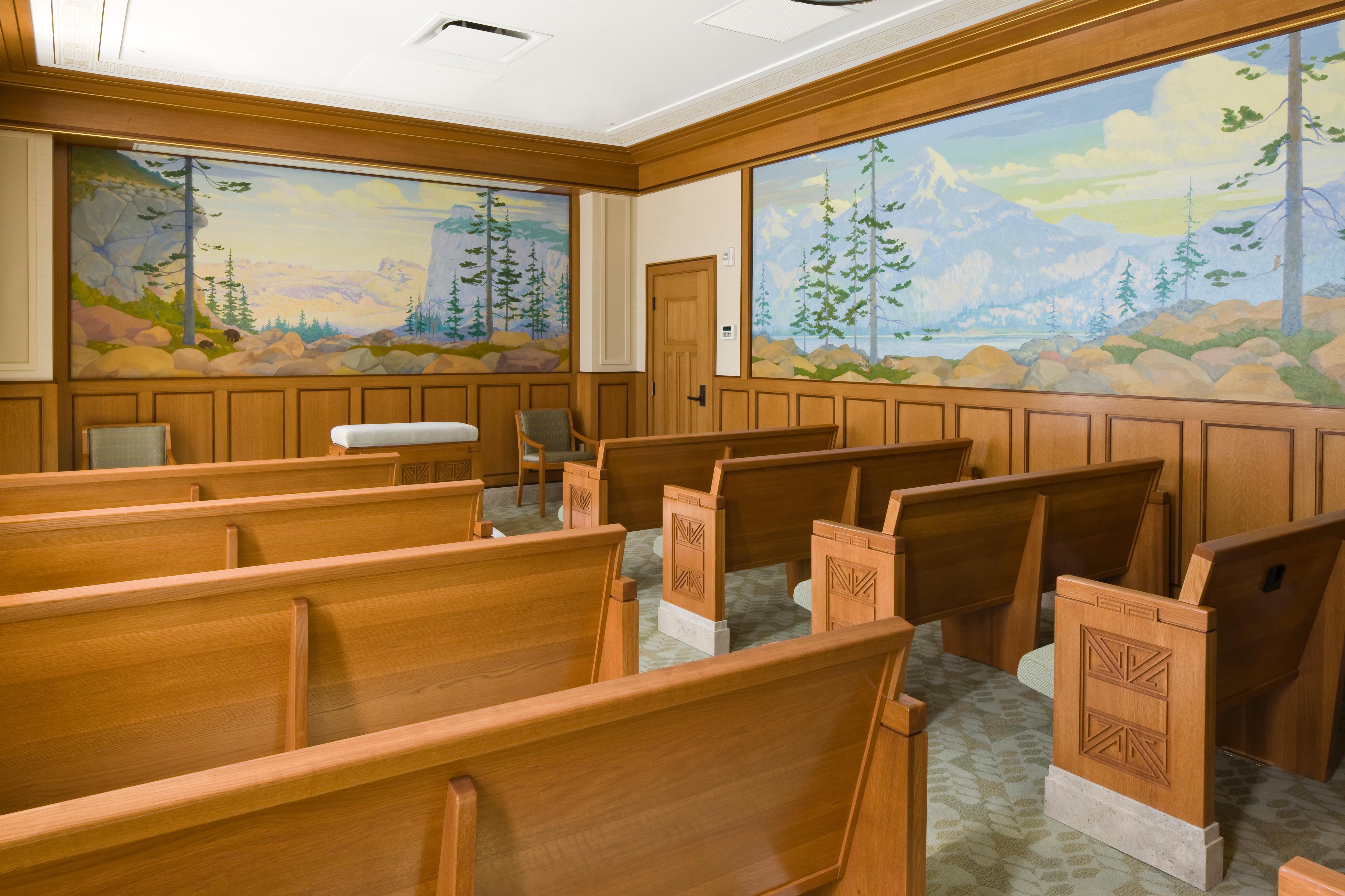
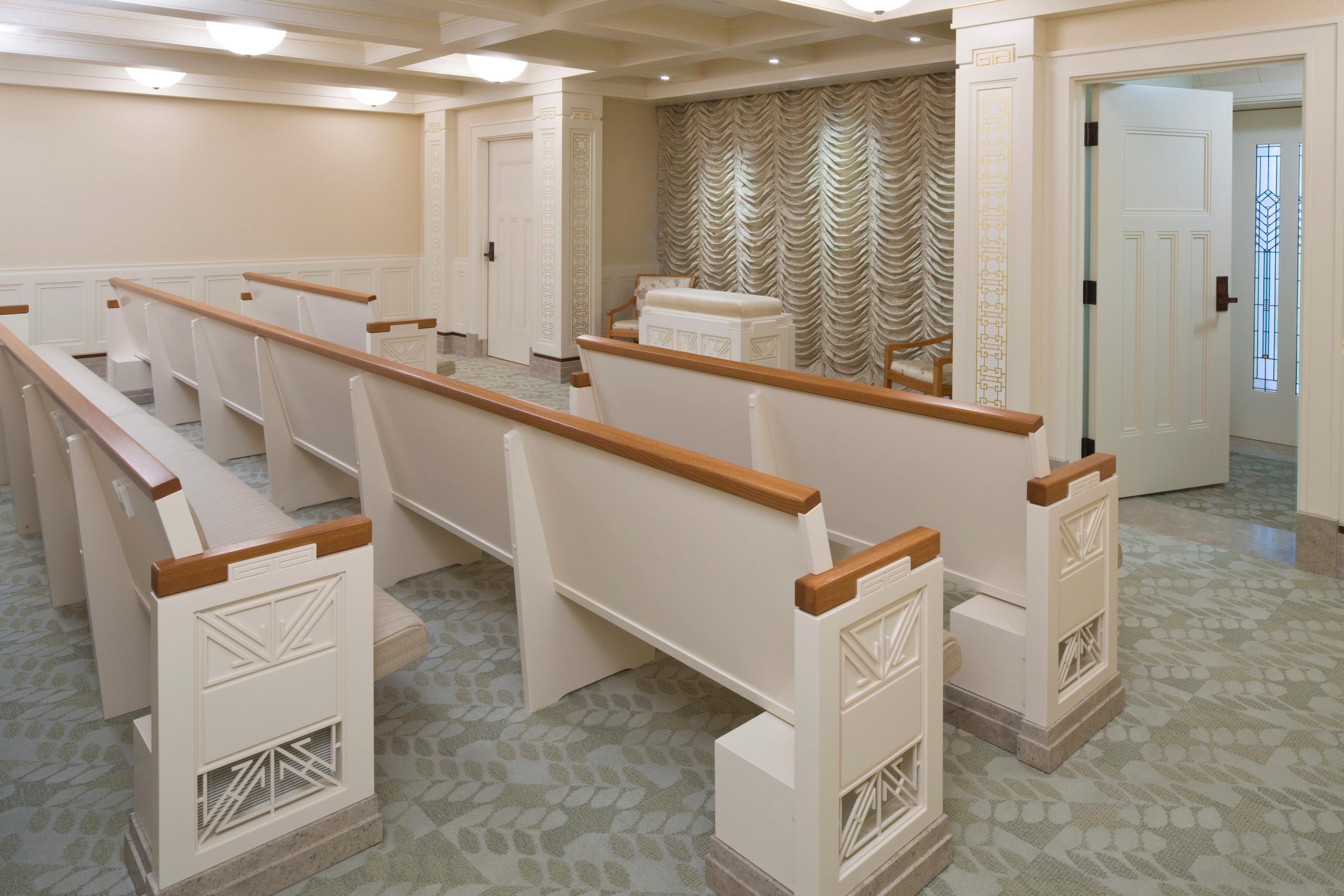
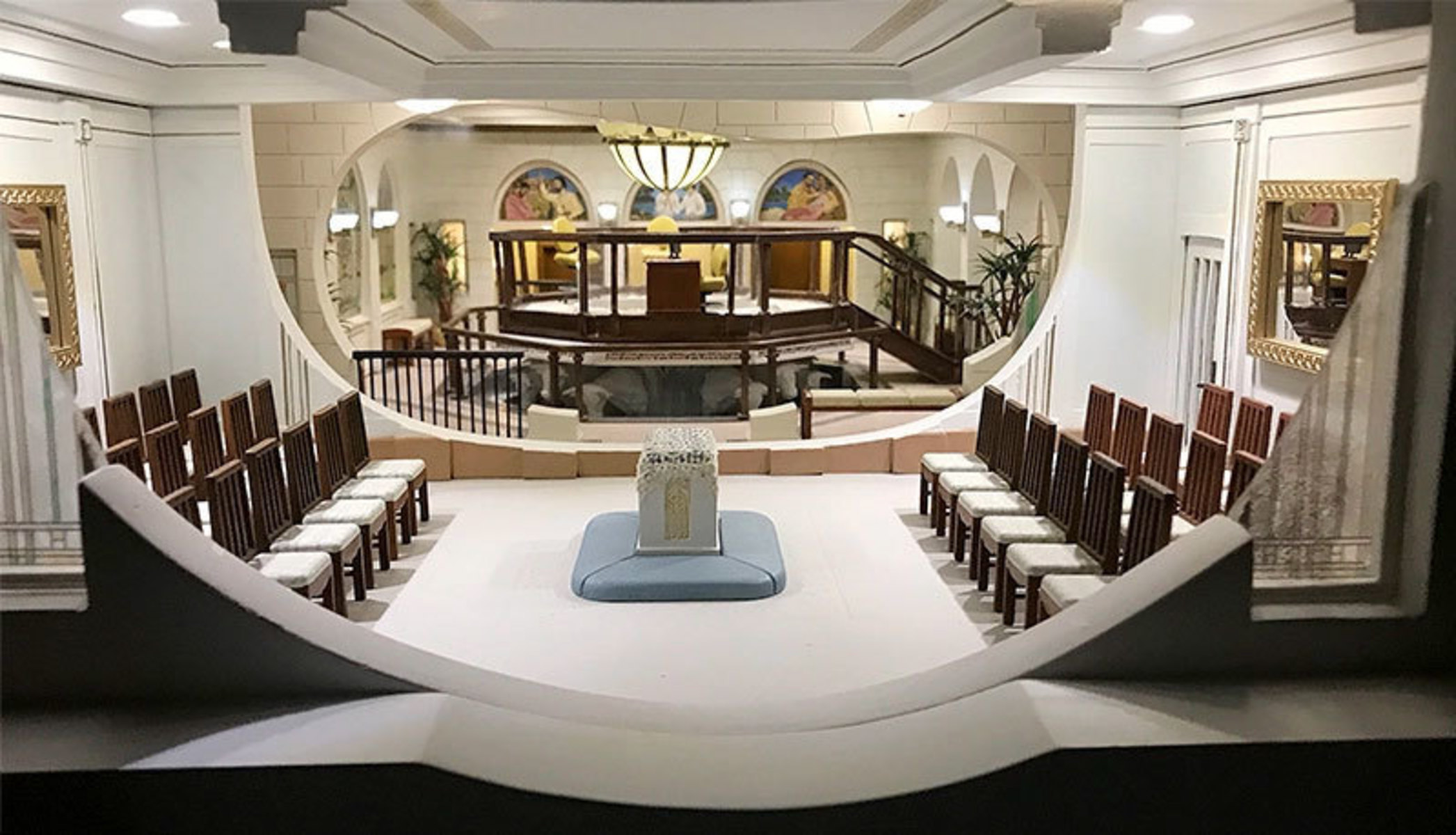
Here is what the exterior and temple grounds look like today:

The pools are original. How did Ralph Woolley, a man with zero construction experience, finish these concrete pools without the oversight of Walter Spaulding? How did he do this with unskilled laborers?
Here is an original photo to compare:

Notice the ornamental spires on the top of the concrete pillars have been changed. I wonder what their original purpose was? They definitely had more of an Old World look.
The complete story of the Laie Temple construction still remains an enigma. The real story has never been told. All we have is folklore and faith-promoting myth. This quote from an author writing in 1986 sums up my sentiments quite clearly:I feel that I must say, in conclusion, that the history of the Hawaii Temple has yet to be written. I have only scratched the surface but I am in the process of doing more. However, much more needs doing. There is yet much more source material to be uncovered. There are many reported occurrences which must remain folklore for lack of supporting evidence. Writing about the temple, to this point, has tended to be journalistic rather than historical and to lean toward the emotion rather than the factual. (Joseph H. Spurrier, The Hawaii Temple: A Special Place in a Special Land, p. 34)
The same could be said for all of the first eight temples "constructed" by the LDS Church after 1847.
I'll leave you with one final thought:
Patterns in scripture are clear when it comes to temples: the Lord only commands His people to build one on earth at a time.
Solomon built one temple for the Jews. Nephi built one temple for the Nephites. Joseph Smith built one temple in Kirtland, which the church lost in 1838 due to the financial failure of the Kirtland Safety Society (a bank). After fleeing through Missouri and eventually landing in Nauvoo, Joseph was commanded to build another one, but they failed to do it in the allotted time frame and were rejected as a people and a church. End of story.
No more temples were commanded to be built after Nauvoo. There is not one, "thus, sayeth the Lord," revelation that came after Nauvoo where the LDS people are commanded to build another temple. Nowhere in scripture does it say that temples "will dot the earth" prior to Christ's return. The purpose of a temple is more than just endowments and ordinances. It is a place where the Lord can come and reveal things to His people. Consider this revelation to Joseph Smith about the promised purposes of the Nauvoo temple:
...Therefore, truly I say unto that your anointings, and your washings, and your baptisms for the dead, and your solemn assemblies, and your memorials for your sacrifices by the sons of Levi, and for your oracles in your most holy places where you receive conversations, and your statutes and judgments for the beginning of the foundation of Zion, and for the glory, and honor, and endowment of all her municipals, are ordained by the ordinance of my holy house, which my people are always commanded to build unto my holy name.
And truly I say unto you, let his house be built unto my name that I may reveal my ordinances therein unto my people, for I deign to reveal unto my church things which have been kept hid from before the foundation of the world, things that pertain to the dispensation of the fullness of times. (T&C 141:12-13, emphasis added)
The Nauvoo temple was not finished in the time allotted, and consequently, the church was rejected with their dead. The "statutes and judgements for the beginning of the foundation of Zion," were never revealed to the church, despite all the temples they have built. I don't believe we will ever achieve a Zion society until God reveals the specific "statutes and judgments" that undergird that society. This will have to be revealed in a future temple that God commands His people to build.
What good are endless temples that dot the earth yet don't produce the fruit of Zion? What good is a multi-billion dollar institution that cannot even produce equality among its own members? If there are poor among us, we don't have Zion.
The first 8 temple construction narratives (after 1847) are too good to be true. These buildings were found, not constructed. Later temples were constructed by the LDS Church, but they were never commanded to do so. If they were commanded, they have never published a single revelation instructing them to build a single temple.
This concludes my post on the Laie Temple, stay tuned for our next temple narrative to explore: Cardston, Canada.

The boards we see sporadically arranged in A-frames might be some primitive form of surveying equipment, but nothing in the photograph is explained to us. One thing is for sure, I see rocky ground that would have been very difficult to dig through with hand shovels and picks, even though steam-powered backhoes were commonly used during this time period.
...a monolith of artificial stone, which, after thoroughly hardening, has been dressed on all of its exterior surfaces by means of pneumatic stone cutting tools, thus producing a cream-white structure which may be literally said to be hewn out of a single stone. ("About the Temple," Improvement Era, 1919)
This statement is interesting because this was the only instance in which pneumatic tools were mentioned. However, none of the construction photos show air compressors, hoses, or pneumatic cutting tools. Air compressors in the early 1900s were steam or electrically powered, and were a rare occurrence in rural areas, especially isolated islands. Pneumatic tools were more likely to be found in metropolitan areas housed in large industrial factories where there was plenty of room for massive steam or electrical engines.
In 1916, pneumatic tools were not generally mobile and used on job sites as they are today. Here is a photo of a typical compressor engine used in 1916:
.jpg)
This is not a machine that could be easily moved to a remote job site on an island in the middle of the Pacific ocean. According to what Spalding stated in his 1973 interview, it was an all day trip driving his overland car on red, muddy, dirt roads from Honolulu to Laie. He said he needed chains to go anywhere on the island in those days, and that most of the materials were shipped to the job site via the railroad:
The railroad carried most of the supplies from Honolulu and went all the way around Kaena Point to Laie, and beyond. Everything except the crushed rock and the Waianae sand was carried by the railroad. There was no way that a truck could even carry a good load over to the...Laie, in those days, it was like going to another island. (Spalding Interview, 1973, emphasis added)
Spalding was obviously lying in this part of the interview, because the railroad never actually reached Laie, let alone "beyond". The rails terminated at Kahuku sugar mill, three miles short of the temple site. And if Spalding couldn't even drive his car to Laie without chaining up, then how did workers load building materials onto trucks or wagons to make the final 3-mile journey on muddy roads? He said himself, "there was no way a truck could carry a good load" over to Laie.
There is no documentation of building materials being offloaded at Kahuku and loaded onto trucks or wagons bound for Laie.
Here is a map of the old railroad. Follow the red line. You can see it hugs the western shoreline and ends just as it crests the north shore:
Even if a compressor was shipped from the U.S. mainland and loaded onto a train at Honolulu, how did workers unload it at Kahuku and haul it the last three miles without heavy equipment?
That the building of the Hawaii Temple could be achieved with such quality while using mostly unskilled labor in markedly remote conditions without the use of heavy equipment, be financed entirely in Hawaii, and be completed within two and half years despite various delays really was quite miraculous. (The Laie Hawaii Temple: A Century of Aloha, by Eric-Jon Keawe Marlowe and Clinton D. Christensen, p. 130, emphasis added)
If an air compressor was used on the temple construction site we do not have photographic or documentary evidence of this occurring. All we have is the statement from Pope made in 1919, two years after the tool would have been used.
But the pneumatic tool conundrum is not the smoking gun evidence that the Laie temple was pre-existing. The best argument against the LDS Church actually constructing this building manifests in the way the narrative describes the concrete work. We're told that Walter Spalding specialized in constructing buildings made of reinforced concrete, but as I'm about to show you, either he was grossly incompetent, or the whole story of the temple construction is a fabricated lie, made up out of whole cloth.
To come to this conclusion, all we have to do is a little forensic study of the construction photos. The anomalies in these photos show us everything we need to know. But first, a statement from Samuel E. Woolley:
We are getting along nicely in the construction of the Temple. [We] have about 40,000 feet of lumber set up in forms ready for the pouring of concrete...(Quoted in, The Laie Temple: A History from Its Conception to Completion, Richard Dowse, 2012, p. 79, emphasis added)
This comes from a personal letter from Woolley to Joseph F. Smith, and it is one of the rare contemporary documents in this narrative, written in June of 1916. However, I believe it was created later and backdated. It does, after all, come from LDS Church History Archives, not a place I trust for accurate historical documents.
But my speculation on the origin of the letter is not the problem here, the problem is what the letter says. When constructing an entire building the size of the Laie Temple out of poured concrete, you would not have 40,000 feet of lumber set up in forms at the same time. This is not the way concrete buildings are constructed, especially with the methods available in 1916.
We're told that the entire building was framed in concrete, including the foundation, walls (both interior and exterior), floors and ceilings, and roofs. A concrete building of this size and scope cannot be poured all at the same time, as that would be a physical impossibility.
Forms have to be constructed for every cubic inch of concrete poured for the building. This would've begun with the foundation and basement walls, then slowly progressed to the main level, beginning with the main floor and walls, then moving up to the higher levels, eventually ending at the roof. Each stage would require building forms out of lumber, pouring concrete, letting it cure anywhere from several days to weeks, then disassembling the forms, and, using the same lumber, constructing new forms in different specifications, pouring new areas of concrete on top of cured sections, etc.
This cannot be done all at once. The concrete poured on the lower levels has to cure for a certain amount of time before it is sufficiently strong enough to hold the weight of freshly poured concrete structures on top of it. Loadbearing concrete has to be incredibly strong and cured correctly or the structural integrity of the entire building can be compromised.
There may well have been 40,000 feet of lumber on the job site, but this would never have been set up in forms all at the same time. This is a massive red flag in the narrative.
Exterior and loadbearing walls of concrete buildings are poured incrementally in what are called "lifts." A lift is a section of concrete wall that is poured simultaneously and allowed to cure before the next section is poured.
In the early 1900s, concrete wall lifts were typically anywhere from 2-5 feet high. Before the lift could be poured, wooden forms were constructed to exact specifications and then squared and plumbed to ensure wall straightness. After the forms were sheathed (meaning that liquid concrete had nowhere to escape during pours) and braced with crosspieces called "walers," the concrete was then poured and allowed to cure. Then, after the concrete was sufficiently strong, the forms were disassembled and reused for the next lift.
This was tedious and time-consuming labor, as each lift required constructing forms that varied in dimension and specification. This would've required skilled carpenters, because even if a single level of wall forms was constructed out of square, the entire building would be compromised. Yet, we're told that the laborers who worked on the Laie temple were unskilled in both carpentry and cement work. According to Walter Spalding:
Mr. Woolley...had at that time something like five hundred Hawaiians, mostly full blooded Hawaiians, working on the sugar plantation that belonged to the Church and he wanted me to use these men. Most of them had no trade. They were neither carpenters nor cement workers or plumbers or anything of that sort, very few. (Spalding, 1973 Interview, emphasis added)
How did unskilled laborers frame a monolithic concrete temple to exact specification in only 13 months? We are not given contemporary documentation detailing how they achieved this feat of construction. Everything we're given is backdated by decades. The only "evidence" we have are construction photos, so let's analyze them.
"A Monolith of Artificial Stone"

There are several anomalies in this photo, as I go through each one, I recommend zooming in on the image.
Hence, the building is a monolith of artificial stone, which, after thoroughly hardening, has been dressed on all of its exterior surfaces by means of pneumatic stone cutting tools, thus producing a cream-white structure which may be literally said to be hewn out of a single stone. (Pope's 1919 article in the Improvement Era)
I'm not sure how rough concrete can be shaped with some kind of air tool (we're not told which kind) and produce this finish without adding some other kind of plastering material to its surface. But if you scroll back up to the photo you'll notice that the finished areas stick out past the concrete, so the concrete has been added to, not cut with air tools.
However, the strangest part of the image is the transition you see from the lower finished area to the rough, upper concrete. Notice the area below circled in blue:

Strangely, the framed-in forms appear to curve around the finished part and continue downward. This makes no sense at all; you would not need wooden forms around any part of the finished area; they are serving no logical purpose. Furthermore, why would you waste labor and resources to cut boards like this to frame around a curved ledge? Before any facade work is done, the form lumber would've been taken down. Also notice how the lumber lines become blurry towards the bottom of the facade. This doesn't make any sense.
Here is the finished temple. Do you honestly think this is the same building portrayed in the construction photo?
Finally, why wouldn't you wait to complete the facade of the building until after it was completely framed and roughed-in? Facades are usually done all at once at the end of the building project using scaffolding, ladders, and lifts. Professional contractors do not construct buildings the way that is portrayed in the first photo.
Let's move onto the next "construction" photo.

We see basically the same scene in this photo but with some slight nuances. However, these variations contain red flags and subtle clues that lead me to conclude that these photos were staged.
First of all, this appears to be a later photo because the height of the left tower is higher and the framing on the right tower is extended.
Remember, this is form framing, not structural framing. It is also known as concrete falsework. Forms are only used to give the liquid concrete a container to set up in. Once concrete is cured the forms are taken down and used again later. The forms in the photo above are not completely built concrete forms. They appear as merely a skeleton on the outside of the building. They would not hold any liquid concrete. They need walers, ties, sheaths, and bracing added in order to complete the forms. And they would only be between 2-5 feet high.
For comparison, here is an actual concrete wall form that has been freshly poured:
As you can see, there is nowhere for the liquid concrete to escape, and the walls are framed squarely and solidly. This is a professional concrete job.
Why can concrete only be poured in short lifts and not all at once?
There are several reasons. For starters, liquid concrete is extremely heavy, and exerts heavy sideways pressure on the forms as it is poured. The deeper the pour, the more pressure is exerted. If the wall forms are too high, there is a much greater chance for leakage and blowouts to occur. Also, concrete has to be worked considerably as it is poured, and this is much more manageable when the pour is shallow.
Remember, we're told there was no heavy equipment used on this temple, so concrete had to be worked with basic tools and primitive implements. Sticks of lumber were used for "rodding", or poking repeatedly into the wet concrete to get it to settle at a uniform density. This was done to eliminate air voids that would cause weaknesses in the walls. It also had to be tampered (compacted after rodding) and leveled to the top of the form with a trowel. The lift area had to be perfectly level before the curing process could begin.
If the concrete was poured too fast or too deep (this could happen if the lift area exceeded 5 feet) then it could cause honeycombing, which means that voids or air pockets would form in it. If honeycombing occurred while pouring a deeper wall, workers may not have had enough time to properly "rod" the concrete before it began to set up. This is why smaller lifts (2-5) were typically employed, as they made each pour much more manageable.
Another reason why smaller lifts were used during this time period is because of the painstakingly slow process of mixing concrete. In isolated areas like Laie, concrete had to be mixed by hand in wheelbarrows or buckets (although Spalding mentions that there was a concrete mixer on site, but can we believe an account published 73 years later?; also there are no photos of this supposed mixer), and then hoisted up to workers on the walls with ropes, pulleys, and derricks. If cement workers on the walls had to wait too long for mixed cement to reach them, then the pour they were working on would begin to set up prematurely, causing potential problems for the structural integrity of the building.
There were many variables that workers had to deal with when attempting to construct an entire building out of concrete.
Do you really think this would've been possible with workers who had zero experience in carpentry and concrete work? And in 13 months no less?
Before we go back to photo anomalies there is one more thing to address: concrete joints. If concrete is poured in small sections, one at a time, then you're going to have joints. There are two types of joints in concrete: planned and cold.
A planned joint makes a nice, clean, stopping point. A cold joint is an unplanned stopping point caused by concrete setting up too fast, problems with forms, or cement not being mixed fast enough. Each type of joint leaves marks on the rough walls of the cured concrete. However, in the "construction" photos of the Laie temple, we see no joint marks at all, which is another red flag. Here is a close up of the rough concrete:

Now for the smoking gun...
So what building are we actually looking at here? Certainly not the Laie temple claimed to a monolith of concrete.
A few more anomalies:


The man circled in blue doesn't seem to fit in the image. His legs seem to disappear into the concrete just below his knees and it looks like he was drawn into the image. The shading on the rectangular windows behind him does not appear natural and his body looks out of proportion.

We see a basically finished structure with what appears to be scaffolding. The men in the lower front seem to be handing bags of concrete, however, it looks like all the concrete has already been poured.
Concrete Ceilings and the Lack of Steel Rebar
This video is worth a thousand words. Construction, believe it or not, it actually difficult to describe with written words, but it all comes together when you can see how it is done with your eyes.
...it was therefore finally decided to build the entire edifice, floors and roofs as well as the walls of cement concrete, reinforced with steel in all directions. (The Laie Hawaii Temple: A History from its Conception to Completion, p. 89)
A single statement doesn't prove anything without a paper trail of documentation. How do we know we are being told the truth here? Where are the steel receipts? Where was it manufactured and shipped from? Were there delays? How much did the Church pay for the steel? These are valid questions that merit answers, yet we can find no documentation.
The Lumber "Miracle"
...at this point, [Ralph Woolley] was desperate. He climbed up...in the steeple of the belfry of the old Laie church...and pled with the Lord. "Tell me what to do. Where can I get some lumber?"...oh about two days passed, and he heard a commotion in the village--people were running to the sea... (The Laie Hawaii Temple, p. 85)
Supposedly, the people were running to a freighter run aground on reef close to Goat Island. This ship was full of lumber, and when Woolley told the captain how desperately the Church needed it, he said, "you can have all the lumber you want for nothing, if you can get it off the ship."
Then apparently, Woolley organized groups of swimmers from among the locals and all the lumber was "swam" to the shore and hauled up to the temple site.
There are, obviously, several problems with Romania's account. For starters, we have no contemporary documentation this event ever took place--no missionary journals, newspaper articles, Church documents, nothing. Secondly, freighter ships did not then, and do not now, cruise anywhere close to the reef on the north shore of Oahu. Many freighters came from San Francisco and followed a direct nautical route to Honolulu, which is on the southern side of the island. No freighter captain would have risked taking the northern route. Also, there are no official reports of ships running aground near Laie between 1915 and 1919.
There are, however, other people who claimed to have witnessed this event: Viola Kawahigashi and two other women interviewed in 1990 (73 years later), and Gus Kaleohano, interviewed in 1970. But again, nothing contemporary. Can we trust oral testimony of events that took place 5 to 7 decades earlier?
The other problem with this story is the sheer irony of it. But the time that freighter ran aground, if it ever did, there would have been no further need for form lumber, because according to other accounts, they already had about 40,000 lineal feet of lumber by June of 1916.
Earlier in this post I quoted a letter from Samuel Woolley, who stated that they had 40,000 square feet of lumber already set up in forms ready to pour concrete. This was in June of 1916, 6 to 9 months before the supposed ship wreck.
And if we look at this story with just a little common sense, we realize that 40,000 square feet would have been more than enough lumber because when pouring a concrete building it is done in stages, and form lumber is taken apart and reused over and over again.
When Walter Spalding was asked about Romania's claim of the mysterious lumber ship, he said he did not recall that instance but that it could've been arranged with Mr. Woolley. More specifically, he said, "I can't say that I remember that," followed by this curious statement:
...for form work you have to have...mostly one inch lumber and two by fours, and uh...most of the shipping of lumber down here in...on...on sailing boats in those days was in larger dimensions which were sawed into whatever sizes were wanted in the market in Honolulu. So...it...uh...there wasn't any way of cutting those...that lumber into the sizes needed for formwork...over at Laie, that I can think of. I mean there wasn't any existing except as the...might have been the Kahuku plantation had some kind of saw mill. (Spaulding Interview, 1973)
Obviously, the lumber miracle story is bunk--even if the Church was given free lumber and workers somehow swam it ashore, they had no way of cutting it to size.
Spaulding's comment about 1" lumber and 2 x 4's is also telling. In order to build complete forms you need studs, walers, ties, braces, and sheathing. Walers and ties could be made from 1" cleating and 2x4s, but Spaulding mentions nothing about sheathing: full sheets of lumber that needed to surround every bit of poured concrete. They would have needed several bunks of sheathing to construct the Laie temple, yet we don't hear a word about this material.
We see an illustration of a typical concrete form below, notice the sheathing occupies the largest portion of the form:
Spaulding also said that building materials "to finish the woodwork" were ordered as early as January of 1917. So again, if there was a lumber miracle ship, it would've come too late.
We could also ask if the lumber from the freighter was used on the interior finish of the temple. But according to official history, this wood was native Koa wood, known to rival "the choicest mahogany," and found all over the island of Oahu.
The Interior
This photo is real, not staged or manipulated. Notice the skies, they look natural and clear, showing real clouds. Notice the clear resolution of the building and scaffolding. Contrast this with the earlier "construction" photos I shared. The difference is stark. Look at the facade of the building, it looks really old and weathered, not brand new as it should've been in 1918-1919 when this photo was taken.
Here is what the exterior and temple grounds look like today:

I feel that I must say, in conclusion, that the history of the Hawaii Temple has yet to be written. I have only scratched the surface but I am in the process of doing more. However, much more needs doing. There is yet much more source material to be uncovered. There are many reported occurrences which must remain folklore for lack of supporting evidence. Writing about the temple, to this point, has tended to be journalistic rather than historical and to lean toward the emotion rather than the factual. (Joseph H. Spurrier, The Hawaii Temple: A Special Place in a Special Land, p. 34)
The same could be said for all of the first eight temples "constructed" by the LDS Church after 1847.
I'll leave you with one final thought:
Patterns in scripture are clear when it comes to temples: the Lord only commands His people to build one on earth at a time.
Solomon built one temple for the Jews. Nephi built one temple for the Nephites. Joseph Smith built one temple in Kirtland, which the church lost in 1838 due to the financial failure of the Kirtland Safety Society (a bank). After fleeing through Missouri and eventually landing in Nauvoo, Joseph was commanded to build another one, but they failed to do it in the allotted time frame and were rejected as a people and a church. End of story.
No more temples were commanded to be built after Nauvoo. There is not one, "thus, sayeth the Lord," revelation that came after Nauvoo where the LDS people are commanded to build another temple. Nowhere in scripture does it say that temples "will dot the earth" prior to Christ's return. The purpose of a temple is more than just endowments and ordinances. It is a place where the Lord can come and reveal things to His people. Consider this revelation to Joseph Smith about the promised purposes of the Nauvoo temple:
...Therefore, truly I say unto that your anointings, and your washings, and your baptisms for the dead, and your solemn assemblies, and your memorials for your sacrifices by the sons of Levi, and for your oracles in your most holy places where you receive conversations, and your statutes and judgments for the beginning of the foundation of Zion, and for the glory, and honor, and endowment of all her municipals, are ordained by the ordinance of my holy house, which my people are always commanded to build unto my holy name.
And truly I say unto you, let his house be built unto my name that I may reveal my ordinances therein unto my people, for I deign to reveal unto my church things which have been kept hid from before the foundation of the world, things that pertain to the dispensation of the fullness of times. (T&C 141:12-13, emphasis added)
The Nauvoo temple was not finished in the time allotted, and consequently, the church was rejected with their dead. The "statutes and judgements for the beginning of the foundation of Zion," were never revealed to the church, despite all the temples they have built. I don't believe we will ever achieve a Zion society until God reveals the specific "statutes and judgments" that undergird that society. This will have to be revealed in a future temple that God commands His people to build.
What good are endless temples that dot the earth yet don't produce the fruit of Zion? What good is a multi-billion dollar institution that cannot even produce equality among its own members? If there are poor among us, we don't have Zion.
The first 8 temple construction narratives (after 1847) are too good to be true. These buildings were found, not constructed. Later temples were constructed by the LDS Church, but they were never commanded to do so. If they were commanded, they have never published a single revelation instructing them to build a single temple.
This concludes my post on the Laie Temple, stay tuned for our next temple narrative to explore: Cardston, Canada.


